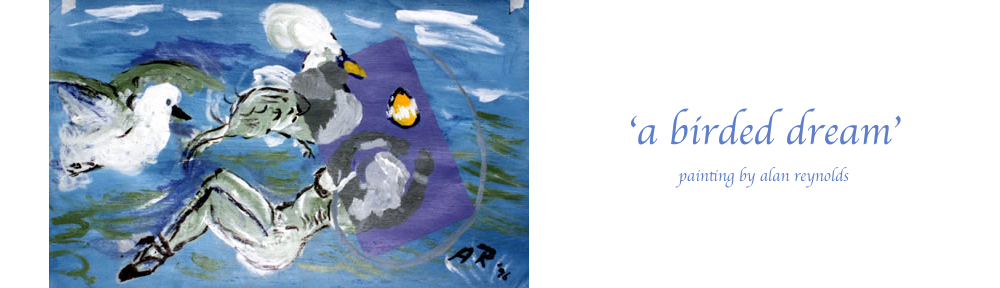
Nearing There

‘You have twelve more years,’ read the angel. ‘Erm. that’s twelve more minutes.
What do you, I mean did you, want to do
with the rest of your life within these finite limits?’
The angel watched me take this in and stew.

‘That’s eight now,’ said the angel. I was whistling,
making mind maps of the places I should visit
if I did had time. Death’s scythe persisted chiselling
at the stump of my lifespan in a rhythm to elicit

a shiver with each chip. I was not buying.
‘It’s a dream,’ I told the angel. ‘You and Death
aren’t really here. You two have not been allying
except in those gory stories like Macbeth.’

‘Till now,’ said Death. Death grinned without a face.
‘There always is a last time,’ the angel added.
‘Don’t you mean “first”? I asked. They both embraced
my pedantry a moment. Then Death patted

my arm, that froze, and said, ‘you’re down to four.’
I sang a childhood song to show sang froid.
Death said, ‘This does not seem to be your year.
You’ve lived your life as if it were a schwa;

neutral, muddling middle, bland, unstressed.
You’ve not done aught that you must answer for
so question time’s not needed. Face stage left,
adjust your collar, try for debonair

as we get in step and march. You’re down to two.’
The angel turned the parchment page and said,
‘Well bless my soul, it was years!’ (Death withdrew.)
‘What will you do from now until you’re dead?’

Schnidly’s Gasconade Gas

His gasconade, his stock in trade,
pretending catachresis
is what he meant in lines he’s rent
asunder in his thesis,

makes Schnidly head of his Sixth Form’s
poetic blunders study
where his mix of misty metaphors
has drove his tutor nutty.

He lets the runner in his ode
fly to the Finnish line
to stub his toe on Maginot
and tentatively entwine

his privates with his general quarters
whilst striking up the band
which gets him reprimanded
by a mandrill Genghis Kahn.

Schnidly is three wines into Monday
when elevenses are served
and he’s sure the Candy Stripers
on his ward think he is perved.

He enrols in near-rhyme sonnets
cause he’s been banned from dizains
and he craves Alsatian curry
when he gazes at Great Danes

like his Hamlet who’s been hamstrung
by Schnidly’s lame production
of Shakespeare’s classic tragedy.
He has brought the Bard destruction.

killing your darlings

Root up your favourites, post them somewhere else.
The land where you first planted them has died.
New settlers hang your mysteries like pelts
of squirrels upon their handlebars, and ride
across the melting ice floes where you dwelt.
They tan your loves they want to hoard inside
their ugly houses built on IOUs.
They desiccate your secrets for their news:

Young commentators analyse your words,
and underscore the syllables you used,
as signs to rustle thoughts you kept in herds.
They’ve cowed you now. The branding’s left you bruised.
Old analysts trawl gems they make absurd
and quarter your last hobbyhorse. Amused?
Retrieve your darlings. Loose them in those cold
and empty places dreams can still take hold.

TFP (today’s featured poem) of 19.9.2011

bull song

When love eludes me totally it smears
itself like frog spawn tamped between my toes
from careless wading. Well, these frequent times
(they are no strangers) hurl me into brawls
I seek with authors, painters, stevedores
– with all who’re man enough that I can joust
against them without first or second thought.
I fight them fair as they fight me. No loss
of contest, money, fame – no future scars –
mar them or me in any mortal sense.
Not even if in battle we meet death.
We circle proudly, cowardly or stoned
and rock-faced heft each other’s fighting weight.

With women it’s not difficult at all
for me, forgetting contest, to enmesh
myself in every maybe, chase each turn.
I watch with them the bowler, not the ball,
am often stumped by simple toss, and try
too hard, too often, and to no earthly use
to plumb for meaning in their wished-for smiles.
The men I see I don’t see save as signs
of what can be achieved or understood.
With girls and wintry ladies I suspect
the universe’s reason to exist.
And find it. Then the gardener drains the pond
and tracks my insights homeward on his boots.

Ahoy

Eight bells on board. Ashore it’s four o’clock.
Time for a drink, the tourists and I think.
The terrace on the waterfront is chock-
a-block with whistles warbling for the clink
of glasses pushed along the long bar’s zinc
and on to trays the waitress swishes out
to praise in all the languages that shout
discretely – we are civilised, though dry –
as sailing Europe pushes the boat out
and wine regales us all with glasses high.

Politicising the Slynog

The Slynog took umbrage and a pot of Earl Grey
and envied the surname Gorringe

not only from cricket and leaders in war
but because it rhymes nicely with ‘orange’.

The policemen took lumps while the Sylnog took two.
Unlike them, he dropped his in his tea.

A broadsheet account gave the Slynog a clue
on the heights of pols’ audacity:

He twigged now how bravery among politicians
comes after the fact, and the skirts

among which they hide till the shooting dies down
are the curtains from whence they then flirt

with the Owners and Losers, society’s classes,
of which pols pretend they are lords

while knowing they’re not, and in fear of the masses
of both groups: their stones, cash and swords.

Pi Eyed

When I tell you this, that pi’s not algebraic,
you say ‘prove it,’ thinking that I take the pi’s.
Although I can’t, I find it elegiac
and, like Grey’s churchyard, simultaneously wise
and useless thwarting warts and evil eyes.
While it’s difficult to think that we should care
about math more than CK underwear
the latter leaves us less than meets the eye
while the former’s models muddle everywhere
because what’s algebraic is not pi.

Fibonacci poem

This
form
forces
fine feelings
into abstruse lines
each longer longing to affix
a meaning to creations made live by febrile minds
and for this new spring trick I thank both you and SlashDot. Well done. Though if continued cumbersome.

(The thank-you in this poem is to Gregory K. who in 2006 wrote on SlashDot: “April is National Poetry Month (and, it turns out, Math Awareness Month), and on my blog, I decided to get people writing poetry based on the Fibonacci sequence. The poems are six lines, 20 syllables long with the syllable pattern 1/1/2/3/5/8, though they can go longer, obviously. I’ve been calling ’em Fibs, and people have been writing them on pop culture, politics, math, and more.”
Gregory K.’s Blog is at gottabook.blogspot.com/2006/04/fib.html )