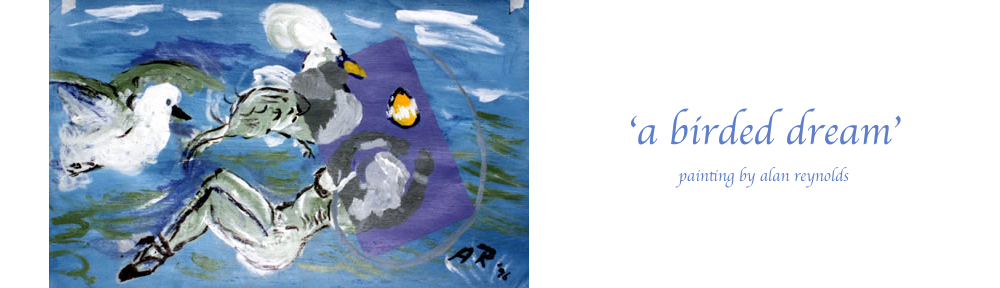
Bus to History and Tourist Swarms

Seven minutes to the next bus. A heron flies
a calm commute about the ancient church.
The grass, so green around the stone-blessed graves,
grows wilder, longer, by the dark canal.
The water, brightened by large water lilies
conceal/reveals a frog, and tiny fish.
Yellow flowers on green, broad floating leaves.
Storm clouds contest the heaven’s startling blue.
A mass of grey occludes the western sky,
the sky’s skirts hemmed at the horizon by thick fog,
cows silhouetted sharply in the false light.
The sun, imprisoned, in prism, by the clouds.
A drawbridge, unattended on this weekday,
stays down while underneath it, red canoes
containing children from a school-trip class …
A large canal, houseboats with their own boats
and a dredger barge maintaining navigable waters.
We cross the ring way. Constant clang of new construction.
Machines assist machines, reshaping roads
and stamping houses on what were green fields
last week or was that a decade. Stop: shopping centre,
then on along a boulevard with flowers
and more canals and sport fields, green full trees.
Then down a topless tunnel/major road
at speed, red poppies on the banks scarce heeded.
Bigger waterways with locks. An actual tunnel
underneath the river to the city centre.
We pop up there, our bus a time machine:
grand houses here for centuries. Tourist swarms.


Written twenty-first of May 2014 on the bus going to Amsterdam. Thank you, Dragon Dictate, for making the transcription from paper notebook so painless.
Street Bones in Spanish Hill Town

I swing
the olive doors’
square shutters — solid wood —
and winter sun runs in and squints
my eyes.

The men
who live up here
have driven off in cars
with rusting doors, to look for work.
I stay.

As stay
the old, the poor;
the gypsy woman who
has fourteen sons, makes baskets, and
who drinks.

Her black
crocheted crepe wool
old wrap protects the sun,
and children running down to school,
from her.

We use
the terrace roof
for breakfast and a lounge.
Not one of the indigenous
admits

he thinks
(she thinks, they think —
new verbs to conjugate)
that we’re less mad than rabid dogs
to sun.

I read
the news in Dutch
and practice Spanish verbs —
except on Tuesdays when I watch
TV.

I look
at CNN.
I need to when there’s war
but otherwise its tag lines make
me wince.

Down on
the dusty street
I sweep up scraps dogs strewed
outside our solid olive doors
last night.

The wind
blows every way
but not enough to shift
the salad left when night strays took
the bones.

The bag,
the plastic sack,
of roasted-chicken bones,
the scraps we hung up on the wall,
had split,

pulled down
by dogs, or cats,
who hunt the midnight streets
for food, by tearing pit-bound bags
apart.

At home
we worry that
a dog might choke on bones
from roasted chicken. Tell that here,
folks laugh.

Riparian Afternoon

How loud the blackbird sings
above this languid stream!
While unseen smaller birds respond,
an otter and I dream.

The otter on the other side,
and I here in my shade,
and flocks of tiny birds on rocks,
comprise the cast that’s made

this afternoon’s performance grand –
like that of yesterday –
and those of every day for aeons.
Sunlight and shadows play

at dancing, while the current dawdles
over ancient rocks.
Oh, everything is perfect here.
We have no need for clocks.

We have no need for anything
that is not with us here.
The blackbird and the otter see
the water’s clean and clear.

The shade that aids siestas
and the burbling creek sounds team
together, and we all unite,
and give thanks. Then we dream.

Homecoming

I can take you there today, if I can find it.
If I can get the key to the padlock on the chain.
You can hold the gate aside. I will drive through.
You click the padlock closed. You climb back in.
We drive across wild meadows where the road was.
We get out where the log bridge washed away.
We ford the creek, knee deep in rushing water.
Our clothes should dry out quickly in this sun
But here the path comes underneath the trees.

Large

Living large confuses me
It seems so sleeping rough
So writing big to use the paper fast
…The lines the bass player laying down
The drummer bent on blind anticipating…
Every August, already going back to school
.
Living large as Livingston in the Congo
Swatting biters that he hoped were flies
A jungle jumble sale of rusty rivets
Recovered from a bone-dry riverbed
Analysis: Is that blood handwriting?
Why do crocodiles have so white teeth?
.
Living largely in a picture book
Words in different languages on the spine
Grinding seashells into sleeping powder
Stopping ears with little bitty hedeghogs
Who need the warmth so much they don’t complain
.
Living large, the Key Largo pirogue sunk
The Cuban blockade broke and up for sale
…The lines the bass player laying down
The drummer bent on blind anticipating…
The beltway runs to Sanibel and back
But no one sees it underneath the waves

It’s a Beach at Midnight

Imagining calories count less in the dark,
he snacks throughout the night continually.
He wiggle-walks across the sand to park
his BMI’s (yes, plural) by the sea.
He would splash in, were fear of pleurisy
less in his thoughts. A box of doughnuts jam
the milkshakes in the thermos near the ham
beneath the turkey biscuits in his hamper.
I am, he thinks, the people that I am.
I shall leave it to these thin sand fleas to scamper.

Callosa Bells

Callosa Bells
Users Manual,
Municipal Sound Media Time Measuring System

Chapter 1, Getting Started
Congratulations on your having chosen
to live here in our modern little town
where the city council’s wisely frozen
time itself in the plaza’s church’s crown
to help you order all your earthly hours
and, by implication, all your life.

Please read each chapter carefully to learn
how to get the most from hearing bells
whose two-and-seventy pleasant patterns
make more sense than many ever know.

Of the fourteen Ones all but two mean quarter past
and the second One’s precisely one o’clock
and the One two minutes later echoes that.

The Twos begin at thirty after midnight
and except for the fourth that comes at two-oh-two
the remaining twelve are markers for half hours
except the third one: it tolls two o’clock.

There are just two Five’s and the first is five o’clock
and the second follows it two minutes on.

First Eleven plays the hour before noon
and fifteen seconds after thirteenth Four.
The second Eleven plays two minutes later.

Of the fourteen Threes they’re two as you expect
reserved for chiming three o’clock. Yes, twice.
And the others; that is, not the fourth and fifth,
all share the meaning of a quarter to.

Most of the Ones, as you now know, are fifteen’s.
Most Twos are thirties, most Threes forty-five.
Some users are surprised to learn the score
of a dozen Fours is nothing; and they’re more
surprised to learn they’re also sixties, each
and every of these dozen Fours is live
with revolutionary zeal and endless means.

Which leave two Fours. It’s interesting the fifth
is the only number sandwiched in between
two of its own kind: the fourth Four and the sixth.

To guess two Tens should take as little art
as knowing they are minutes (two) apart.

Which leaves our hands at nothing or at Twelve
of which, it follows, there are only two,
one two minutes after every midnight
and one to close this system every noon.

Finely Summer

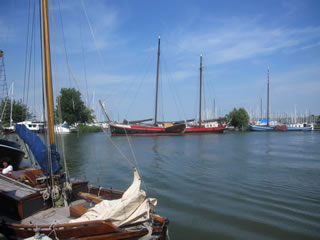
Summer day in Monnickendam harbour

Finally summer, finely summer, and the sailboats
parade with purring motors past the quays,
meandering to berthings near the bridge
the harbour master raises on the hour.

Disembarking for an ice-cream or a shower,
the passengers abandon deck and bridge
for pubs and grillrooms harvesting these days
when no one needs a wrap or winter raincoat.