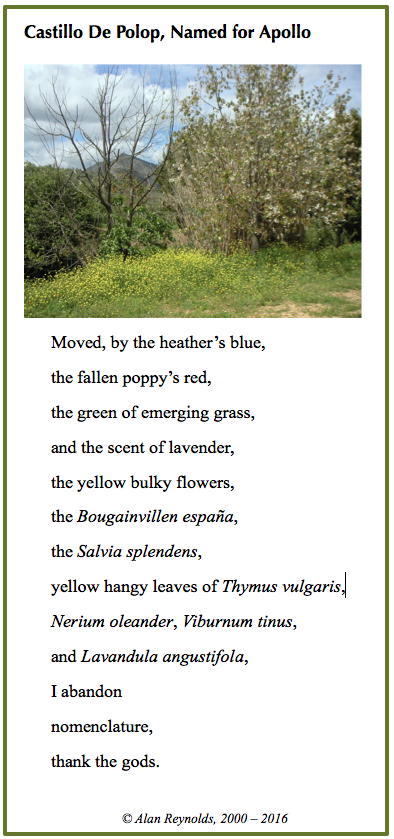
Castillo De Polop, Named for Apollo
Image
2
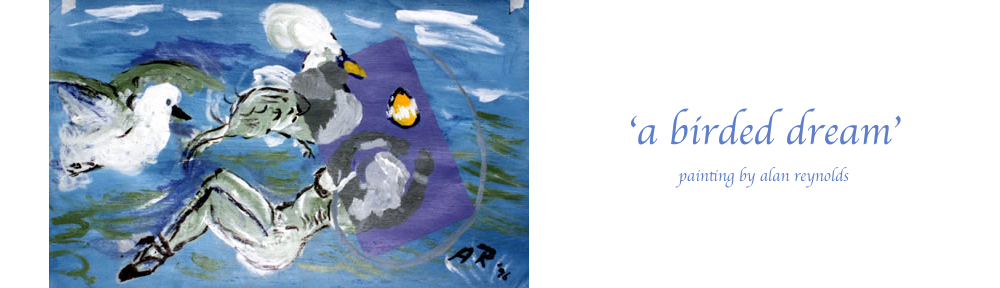
The gargoyle on our front door’s name is Giles.
I mean the gargoyle’s name. The front door has no
name itself, far as Lucinda knows
and she’s the expert here, say friend and foe,
about strange creatures’ names. What she has read
confirms my observation: Giles just hangs.
He never moves a muscle. He just hangs
his tongue out in that way he thinks beguiles
the girl gargoyles, who turn away and red,
and act as if collectively they know
Giles looks the part but secretly is faux.
His tongue, for one, is longer than his nose
and that, among his kind, Lucinda knows,
means we’ve a loser latched to where Giles hangs
which makes her count like James Brown two, tree, foe
and knock the front door silly with old Giles
or try to twist his tail to make the no-
tarial tables she says Giles has read
rotate his innards till he’s copper red
from stub of tail to sooty snout-like nose.
The thing you’d think a gargoyle has to know,
who’s passed his way, he doesn’t — ’cause he hangs
the wrong way up to notice. Poor old Giles!
She’d melt him for the metal but he’s faux
and possibly mâché, a paper foe
for stopping demons. What Lucinda’s read
to me about non-starter gargoyle Giles
would fill ten comic books: his cony nose
and fairly flat-arched long left foot that hangs
across his right so long the crease is red
with rust. She says she thinks, or’s read,
in a book by some lost soul yclept Defoe,
that demons fear confronting iron that hangs,
and Giles ís hung: it makes his eyes go red
while tears track rills of oxide down his nose.
Inverted he’s a sight that doth beguile.
Oh, gargoyle moms, before you hatch more Giles,
ensure that no foe hangs around who knows
that Giles ain’t hung the way Lucinda’s read.
A cormorant is fishing my front porch,
a shelf of small stones sloping under sea
so clear I see the trace at thirty yards
each time he dives. The surf sounds subtle here.
A gathering of gulls lights on my left
enhancing the blessed solitude I feel.
No human in my line of sight that way:
just tiny surf, and dozing gulls, and hills.
Sharp hills, that turn to mountains as they climb.
White gulls fly over, checking what I write.
The rest remain at rest; we share some sun,
and comment, in our ways, on how the wind
is lighter, and how ozone smells so clean.
More rocks revolve with every single wave
than men have years of history on this earth,
and each rock tells a story seagulls hear.
I hear the stories too, and, like the gulls,
take comfort I don’t understand the words.
The sky has disappeared
or is it me
who ceases when there’s
only sea
and grey horizon
lightens into white
identical to sky?
When every sight:
the mountains, buildings,
and the trees;
the plastic medlar covers,
the hives of bees;
hill-climbing coughing trucks
filled with wet goats;
through-wetted web nets
and the wakes of boats —
go missing, mingling,
mixing in the haze.
Are they what’s gone
or am I in a daze
to think discernment
matters in the theme?
Today all Costa Blanca
is one dream.
Come visit me alone, for one’s enough
that any quorum lacks to vote defeat.
Come visit me in Cadaqués. We’ll hide
out basking on the baking rocks and poach
sweet views of pulchritude.
                           The octopus,
as sturdy as a horse except no bones,
inks out its living in the open sea,
and I eke mine on land.
                          It’s marginal,
my living, but, like me, sufficient here.

I catch up passing tourists with my song
and share with them their wine and daily bread.

Unlike the octopus’s prey, mine live
to warn the others, though they never do.
They boast instead they stole away my song.

They sing for years the tunes I have forgot.
I misspeak verbs in languages they learn

in later years, the better to esteem
the wisdom of the octopus we eight
or was it four flushed. Come visit me. We’ll hide.
I lounge alone on Peter’s patio
that frames the gathering grey clouds storming past
between high-hanging, stock-still clouds of white
and me boxed here against the coming night.
The sun scores silhouettes on banks of white
and writes initials on the crescent moon.
The moon, self-centred from this patio,
backlights high-flying swallows as they flow
and flip, appearing swiftly from stage left
to exit right as cannon fire that soars
up moonwards. Downstage, modern feasting Moors
and Christians re-enact their ancient wars.
 Earth Tourist