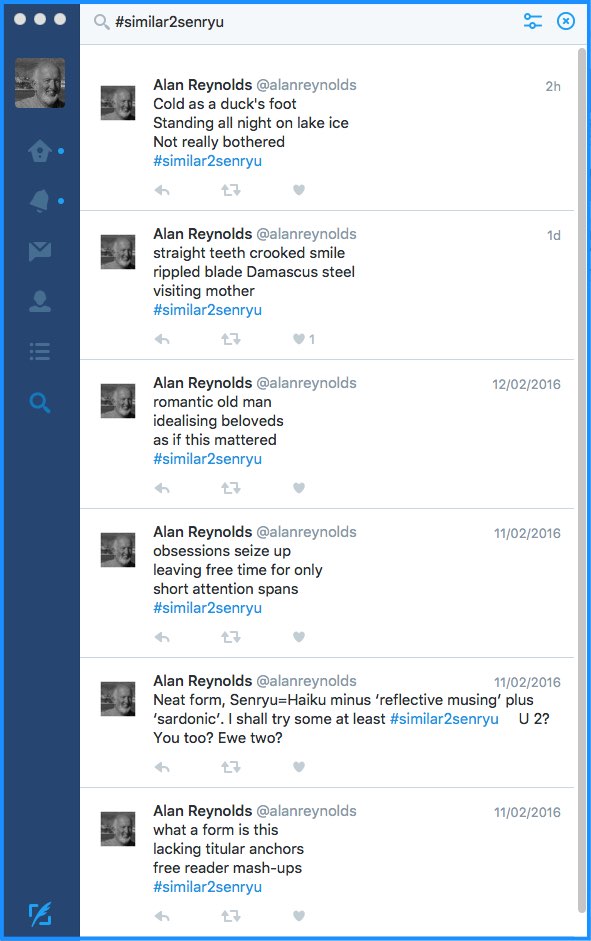
#similar2senryu
Reply

A cormorant is fishing my front porch,
a shelf of small stones sloping under sea
so clear I see the trace at thirty yards
each time he dives. The surf sounds subtle here.
A gathering of gulls lights on my left
enhancing the blessed solitude I feel.
No human in my line of sight that way:
just tiny surf, and dozing gulls, and hills.
Sharp hills, that turn to mountains as they climb.
White gulls fly over, checking what I write.
The rest remain at rest; we share some sun,
and comment, in our ways, on how the wind
is lighter, and how ozone smells so clean.
More rocks revolve with every single wave
than men have years of history on this earth,
and each rock tells a story seagulls hear.
I hear the stories too, and, like the gulls,
take comfort I don’t understand the words.
The sky has disappeared
or is it me
who ceases when there’s
only sea
and grey horizon
lightens into white
identical to sky?
When every sight:
the mountains, buildings,
and the trees;
the plastic medlar covers,
the hives of bees;
hill-climbing coughing trucks
filled with wet goats;
through-wetted web nets
and the wakes of boats —
go missing, mingling,
mixing in the haze.
Are they what’s gone
or am I in a daze
to think discernment
matters in the theme?
Today all Costa Blanca
is one dream.
Here’s this Death’s-head Hawkmoth travelling solo,
high up, slowly. Banking on solar-guided
day flights, tracking lunar beams through the dark in
honeycombed flight dreams.
Up from Egypt, confident to her wingtips,
desert sunsets lighting her port side. Nights flown
on the same course. Gauging the safest glide paths,
dreaming the touchdown.
Fog-bound days logged over the slate-grey sea chop,
sturdy thorax beating down square-rigged breast strokes
till Swiss cantons stand in for whitecaps. Cruises,
pressing up wing loads.
Light rain welcomes flight’s closing leg to refuge:
vespers’ vistas. Death’s-head knows honey beckons:
bulging golden beehives awaiting her drop-in.
Drills down to get some.
Two months’ perfect homing is paid in sugar.
Sweet with fuel needed for last feat: laying
eggs in garden plants’ shade. Each egg grows its own
honeycombed flight dreams.
I lie in a tent on a sandbank in the river
and wonder would I hear the water rise.
The otter’s snoring serves as metronome
for the heartbeat pace of words the moonlight limns.
I wake and all realities retreat,
except the one that’s standing watch today.
In the south of France Lucindas lean on trees,
or dance. For me. For joy. Up here the rain
leaches colour from the just-turned falling leaves.
I shall never see MacArthur Park again.
I see a shimmering line, a lifeline or a serpent,
undulating in the inshore moonlit current,
so close by I could touch it if I woke …
Downstream, or up, a church bell counts the hours.
Four chimes. Clouds mass. It is so sudden dark.
A priest of gentle parentage gets shriven,
or knotted, now for naught his pack of genes
that travelled aeons to arrive in him,
cold on his perch, before the furnace door.
Cold breezes stir the tent. Up high: the jet stream.
Clouds thin. They go. The smuttily full moon
invades the damp sand, wakes the snoring otter.
It caught a fish for each of us last evening.
I called mine sushi. The otter ate both heads.
We spoke the way that mammals do cross-species,
before it slept, of whether there’d be weather.
I need deep sleep, a day of dry, a boat,
the fun of congregations without creeds.
The otter wakes. It watches where that snake,
or pliant water plant, hangs in the current.
We fantasise together it’s a god,
our refuge for describing what’s unknown.
We wish for more fish. I wish for a fire,
and the otter for a thing I do not know.
I shall never see MacArthur Park again
or the reality that has the watch tomorrow.
This poem is for Manuel van Loggem
who gave me pleasure with his meagre book
Letternijen that I read in from time to time
even some evenings before he died.
I liked his provoke-verbs, his sour tales,
his animals, and his japes at literature.
While they survive him in his book, perhaps some Where
exists where Manuel learns whether curse or prayer
worked better. As to which, I wish him well.
Manuel van Loggem in his 28-page book Aforismen en andere letternijen, uitgever, Deventer, Ypse-Fecit, 1989, 300 numbered copies:
‘Ik: Is er een leven na de dood?
God: Kom maar, dan kun je het zelf zien.’
Translations:
1. Me: Is there life after death? / God: Come on, you can see for yourself.
2. Yo: ¿Hay vida después de la muerte? / Dios: ¡Vamos, usted puede ver por sí mismo.
Water birds debate will there be sunrise.
The ayes prove right. We start another day.
Come visit me alone, for one’s enough
that any quorum lacks to vote defeat.
Come visit me in Cadaqués. We’ll hide
out basking on the baking rocks and poach
sweet views of pulchritude.
                           The octopus,
as sturdy as a horse except no bones,
inks out its living in the open sea,
and I eke mine on land.
                          It’s marginal,
my living, but, like me, sufficient here.

I catch up passing tourists with my song
and share with them their wine and daily bread.

Unlike the octopus’s prey, mine live
to warn the others, though they never do.
They boast instead they stole away my song.

They sing for years the tunes I have forgot.
I misspeak verbs in languages they learn

in later years, the better to esteem
the wisdom of the octopus we eight
or was it four flushed. Come visit me. We’ll hide.

