
Shooting Star
Image
Reply
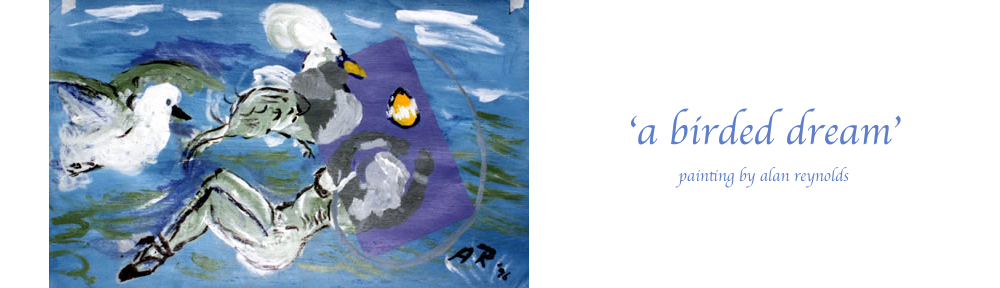

Of the creeds of horses and beliefs of dogs,
I claim no knowing—only this:
they ponder mine as little as I ponder theirs.
Even here, in this, I am shaky, ignorant.
Knowledge, fleeting as always, escapes me now,
and the themes I grasp leave me cold in the autumn
of this perfect day, free and out of work,
not the slightest bit confused on which is which.
The waitress frees the chained-together chairs.
I choose the best chair, how we humans know
a mystery to the only other souls:
the tourist horse and the dissipated panting dog.
The others—there are no others here—
I cannot see, but I admit their presence
and fear I may in my ignorance offend them,
fumbling phrases, doubting their rite:
which serves as wafer, which as wine.
The waitress brings me fresh orange juice. I wait.
‘What heavy thoughts,’ the lying dog must think,
‘occupy the draught horse, dreaming its fly whisks,
avoiding whinnying except when part of the service.’
A man in shorts, cap, and camouflage shirt
ascends the eight, marble, steps next door
and goes inside, the horse seems sure, to hosannas.
It is early and with no custom, and the chef himself
provides me, seated outside in the best chair,
my fish and loaf while I turn at the sound of hooves
behind me, across the Prinsengracht, where barks
pursue the horse, mane damp with the city’s weight,
propelling, by pulling, a cart of intentional tourists.
A dove, conspiratorial and keen,
settles in the chair beside me, murmurs,
‘Where does all this lead?’—not kindly, but slyly.
I give him thoughtless invective, the only kind
that counts against me. Father, I have sinned.
The sun blinks out; the phantoms fold into shade.
They, the dog and the draught horse, reappear
on the tales of clouds resuming autumn coverage
of the best chair, mine. Guests arrive.
Each claims the best chair as her throne,
silent as we feast on separate truths,
while the dog and horse dream far beyond us.

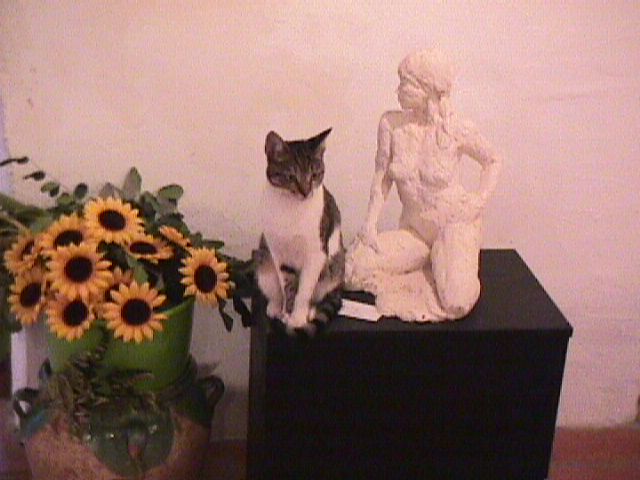
Sam explains to me there is a concave mirror
in the base of the sun that concentrates
the rays from the larger lighter moon
to warm our hours when the moon’s asleep.
I ask Sam about his sister
and he switches and twitches
his tail and the light in his
eyes is not Mercy.
The elections of yesterday
have gone unreported
among the almond trees.
I drop the twigs and sticks
upon the growing pile
and would light it
had I matches.
I have the Gaelic
but only in boxes
not near enough my tongue.
Samuel is good at ellipses
but Meg, his sister, excels.
She says volumes with each
silence, and cares
little that no sheep
partake of grass among
the goats.
‘Don’t blacken me with pot,’
I say to Sam.
Meg pretends to listen
but her ears are on
other frequencies
and spiders are unsafe.Meg is hunting moths tonight,
leaping at nothing in the dark
and returning with munchies.
I hear her chew them but
I did not hear her land.

The squirrel of Buddha stands stock still and tall.
For a squirrel. She blinks and history unfolds.
Whatever you think should happen does somewhere.
It all comes back, in time, to Buddha’s squirrel.
A mysterious Editor reads back what I write.
I flit between rare visions seeking meaning.
What does the squirrel of Buddha symbolise—
wisdom, stillness? Answers go unheard.
I see a warm plate heaped with scrambled eggs
cooked in so much butter that the whole room glistens.
I eat until I am sated and beyond.
Somnolence returns as arteries clog.
‘With his arms and shoulders folded like a bat’s.
he sleeps, a gut tube trailed by knot-kneed legs.’
‘Surely “not” or “knocked”,’ says Editor. I stay
my quick reply. Tomorrow I’ll revise.
The squirrel intones, ‘They were excitable. They died.
They were alive and vile a century ago
until the year of our Lord 1915.’
The watchful jackdaw asks me, ‘When was that?’
Morose, what the cat lacked,
or was that morsels?
Sylvester attended breakfast,
that break time in bad marriages.
Maria howled.
‘The ideal that celibacy
beats off claims
that marriage is moral
but not for the godly
isn’t good.’ She purled.
Sylvester laughed.
Perhaps not noting the tears
in her regarding eyes.
‘Crepehanger,’ he said.
‘Dyspeptic from mousing around?
When we eloped, you didn’t say,
like Donne, to tip your paw
would “impossibilitate”
our lives.’
‘You battle faith,’ Maria said
in what she thought was answer,
‘and feed it to your reason.
No one’s glad.
Our years of marriage
number as our friends.
We talk things out with them
instead of going.
I lost my first friends
marrying (them or me),
and second sets departed
with divorce.’
‘Don’t be so glum,’
Sylvester took more mouse.
‘Your melancholy’s giving me the glums.
Brooding, cheerless dowager of doom,
confusing Eliot’s bang and whimper with
post coital tryst,
I’m going out.
The Doury you brought
me is aptly named,
as are the saturnine tales
you relate, that whip up
no emotion but disgust.’
‘Like gnarled misshapen branches,
you are knotted,’
said Maria. ‘No wonder
I can’t reach your crabbed soul;
it reasons with its belly,
has no ears.’
‘No,’ Sylvester said,
‘I’m more like Keats,
in that I’ll give you
plums, but not my time;
the burls upon my tree
as scratching post,
but not one look into
my private soul.
Devotion’s but annoyance to me.
Please look alive! We leave
to hunt at three.
Fidelity’s for dogs.
And you, who mewl this noon
of marriage pains, can’t
count one pleasure
celibacy brings.’
‘Cel-i-BA-cy? Ach,
Sylvester, PLEASE!
If thou must metric
do it right, or cease.
And don’t cite sight
rhymes back to put me down.
I’m free as verse,
as Bismuth in his bath.
When you are out
my vapours go out too.
The sick at heart
can scarcely warm my hearth.
So leave, for good.
We, married for a day,
(or was it for a night?)
shan’t share a nest.
Go howl into the night
and I shall raise MY kittens
well alone.
You are too old to marry:
second-hand, or, better,
furniture the shops could
never sell.
Now old, morose, and captious,
cat around
and see if I care.
Run along now. Hound!
Misanthropy would be your
human name.
Like Eliot’s cats you
hide your feline nomen
I bet you mutter
there are those who care,
but even mice, whose reasons
we can’t know,
would find “Sylvester”
sad enough,
would go a hundred mice
lives and not ask.’
‘You have no friends,’
the tom, fair stung, retorted.
‘That’s what I said,’ Maria
purred. ‘Our marriage
has no years.’
Her claws struck out
and stroked blood
from his ears.
‘I’ll give you “doleful”,
“woebegone” as well.
“accursed by fate”
and “desolate.”
Now go.’
Sylvester’s marriage,
fluid, leaking out
(he never realised it)
down the spout,
he sprang onto the
windowsill,
the while
he dreamed of
ancient Mormons.
Goofy smile,
not dry, nor tart,
not sullen,
greased his face.
‘Irascible?’ he asked his smouldering
mate.
‘Solein today, from something that you ate?’
The hangdog look he gave her
broke her up.
She licked his ears.
The faith that moves
small mountains
ain’t for cats.
Nor is the artificial,
sterilised
state that Shaw called marriage.
What’d he know?
Content, these cats,
to sour but two lives,
they wallow in unsociability,
and pride themselves on
being so aloof.
An eremitic
couple on the prowl.

 Earth Tourist