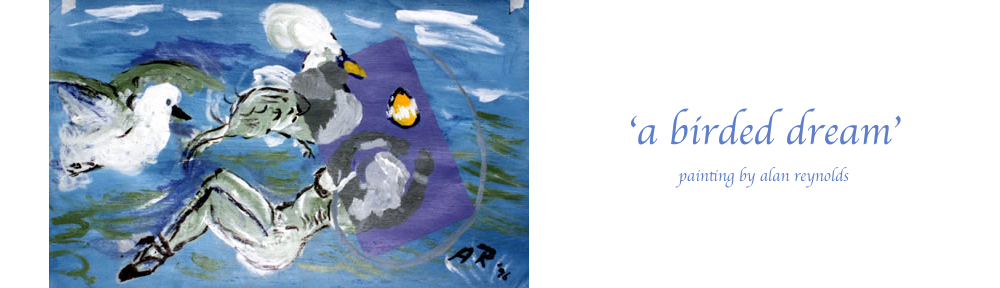
It had been five years almost to the day, and still they remembered the ashes. The terms of his will had been obeyed. His ashes, separated by weight into equal portions, had been spread on the pavements in front of each of his three wives’ houses.
The ashes had long since blown away or tracked indoors. Better not to think much on it—go on living and remember him the way he is; that is, not at all.
The children, some his by birth and others by mutual affinity, saw each other rarely.
The strangeness of running into each other caused them to wonder what they had in common and imagine it was him.
It was a false imagining. No one had ever known him in a way another did. He had been a spirit mirror, not to cheat or change anyone—especially not himself.
He existed only in relation to those he loved. He had been a mirror for each of his wives’ spirits. One remembered him laughing at dawn in hides waiting for spoonbills. One still reached for legal arguments she knew he’d enjoy. The third kept the daube mouton recipe they had developed together.
A son who enjoyed being difficult remembered him as a high-flying mental buddy. A daughter remembered him as an enthusiastic follower of the sport in which she excelled.
His father had died when he himself was very young. He worried all his life that he had failed to do something—he didn’t know what—that would have kept his father alive.
His mother sensed other people’s feelings. He observed their interests.
She knew he was observant. She asked him did he not feel horrible about poor old Mrs. Cazel’s fall in her hen house? Didn’t he feel wonderful about Mr. Jones’ winning a holiday for his family?
He had not. He had had his own feelings and emotions—about girls, and fantasised heroics.
He enjoyed mirroring. It pleased him to try on another person’s habits, the way an actor enjoys a new role.
Those he had liked enough to mirror remembered only the reflection of their own spirits.
I wonder if he ever knew whether he liked it.
Tag Archives: Relationships
CATTING AROUND
Morose, what the cat lacked,
or was that morsels?
Sylvester attended breakfast,
that break time in bad marriages.
Maria howled.
‘The ideal that celibacy
beats off claims
that marriage is moral
but not for the godly
isn’t good.’ She purled.
Sylvester laughed.
Perhaps not noting the tears
in her regarding eyes.
‘Crepehanger,’ he said.
‘Dyspeptic from mousing around?
When we eloped, you didn’t say,
like Donne, to tip your paw
would “impossibilitate”
our lives.’
‘You battle faith,’ Maria said
in what she thought was answer,
‘and feed it to your reason.
No one’s glad.
Our years of marriage
number as our friends.
We talk things out with them
instead of going.
I lost my first friends
marrying (them or me),
and second sets departed
with divorce.’
‘Don’t be so glum,’
Sylvester took more mouse.
‘Your melancholy’s giving me the glums.
Brooding, cheerless dowager of doom,
confusing Eliot’s bang and whimper with
post coital tryst,
I’m going out.
The Doury you brought
me is aptly named,
as are the saturnine tales
you relate, that whip up
no emotion but disgust.’
‘Like gnarled misshapen branches,
you are knotted,’
said Maria. ‘No wonder
I can’t reach your crabbed soul;
it reasons with its belly,
has no ears.’
‘No,’ Sylvester said,
‘I’m more like Keats,
in that I’ll give you
plums, but not my time;
the burls upon my tree
as scratching post,
but not one look into
my private soul.
Devotion’s but annoyance to me.
Please look alive! We leave
to hunt at three.
Fidelity’s for dogs.
And you, who mewl this noon
of marriage pains, can’t
count one pleasure
celibacy brings.’
‘Cel-i-BA-cy? Ach,
Sylvester, PLEASE!
If thou must metric
do it right, or cease.
And don’t cite sight
rhymes back to put me down.
I’m free as verse,
as Bismuth in his bath.
When you are out
my vapours go out too.
The sick at heart
can scarcely warm my hearth.
So leave, for good.
We, married for a day,
(or was it for a night?)
shan’t share a nest.
Go howl into the night
and I shall raise MY kittens
well alone.
You are too old to marry:
second-hand, or, better,
furniture the shops could
never sell.
Now old, morose, and captious,
cat around
and see if I care.
Run along now. Hound!
Misanthropy would be your
human name.
Like Eliot’s cats you
hide your feline nomen
I bet you mutter
there are those who care,
but even mice, whose reasons
we can’t know,
would find “Sylvester”
sad enough,
would go a hundred mice
lives and not ask.’
‘You have no friends,’
the tom, fair stung, retorted.
‘That’s what I said,’ Maria
purred. ‘Our marriage
has no years.’
Her claws struck out
and stroked blood
from his ears.
‘I’ll give you “doleful”,
“woebegone” as well.
“accursed by fate”
and “desolate.”
Now go.’
Sylvester’s marriage,
fluid, leaking out
(he never realised it)
down the spout,
he sprang onto the
windowsill,
the while
he dreamed of
ancient Mormons.
Goofy smile,
not dry, nor tart,
not sullen,
greased his face.
‘Irascible?’ he asked his smouldering
mate.
‘Solein today, from something that you ate?’
The hangdog look he gave her
broke her up.
She licked his ears.
The faith that moves
small mountains
ain’t for cats.
Nor is the artificial,
sterilised
state that Shaw called marriage.
What’d he know?
Content, these cats,
to sour but two lives,
they wallow in unsociability,
and pride themselves on
being so aloof.
An eremitic
couple on the prowl.
Harps and Violent Inns
The hearts and violins they’re passing out
don’t hold a candle to the ones we burned.
The fountain has cracked. Red rust leaks from the spout
beside the pool where once our bodies turned
as one creating underwater sun.
The courtyard where we danced is sharply paved
with broken glasses. We broke everyone.
The vineyard where in spring we misbehaved
has been cut down. I find the blackbird’s nest.
The broken glass reflects the empty shells.
I try to smile, pretending it is best
that you’re not here to hear the muffled bells
that toll the march of autumn through the plain
as the shells give up their colours to the rain.
presented June 2001 in The New Formalist ISSN:1532-558X
Deuced Pas de Deux
entrée
He:
‘I am alive today, and dancing in the wind
that cools the grass the sun is burning brown
The dunes demur, and gliding gulls rescind …’
She:
‘His splayed legs, in shorts, displayed from calves to toes
are dead ringers for plucked turkey tom cadavers
as far, too far, as epidermis goes.’
adagio
stage direction
She makes a wish and writes it on a paper
and seals it inside a bottle with a kiss.
they dance, both singing:
‘We laze upon the littoral and think
we are thinking. Thoughts as thoughtless as the waves
advance and crest and surge onto the sand
in which despite their fecundity nothing grows …’
her variation:
‘A plucked turkey carcass, bled and oven bound
shows better skin tone than the hide that’s found …’
his variation:
‘The deadpan surly words mask how we flirt …’
coda
The stake-fried chicken sizzles and goes out
for waffles.
[Shurly chicken-fried steak? Ed.]
Gone Song
I’ve been pushed away so often that I’ve left.
You don’t notice nothing missing. You don’t look.
And I left the music playing and the broken rocker swaying
and my heart there where you pressed it in the book.
The screen door slammed behind me in an off key
and the drums rolled thunder on the radio.
I looked back and saw you reading and I hoped I saw you cry
then I saw you pick the phone up, say, ‘he’s gone.’
Formula Translation
A poem with ‘higher math and logic‘ (?) symbols.
Please click Formula Translation with marks to see it (it’s a pdf file).
Water Bearers Bringing Gin
It was Spring, a time that Grungy Dinah pined
for love. Spring sprang sap-hazardly. Dawns lengthened.
Eves shortened. Adams appled. Fauns were fined
when caught flagrante delicto. Their lusts strengthened
poor Grungy Dinah’s dreaming that her own fate
involved one couple’s coupling, wherein she
was the female actor (actress?), and the ‘he’
was whichever ‘who’ three gins proclaimed her mate.
Not ‘whom?’ she pondered. Days and fortnights passed.
The winds of grammar wound their winding sheets
around her nouns and pronouns. Sap was sassed
till Spring wound down in Gunga Din defeats.
Falls
The poems that I learned as a child
– I’ve forgotten the words –
let rhythms glide by where I stand
on a rock in the creek.
I gaze at the banks where I saw
the black moccasin smile.
That was so long ago. Now I look
way upstream to the falls
remembering Grandfather laughing
while helping me climb
through cool spray and shadow to sun.
Where had we been going?