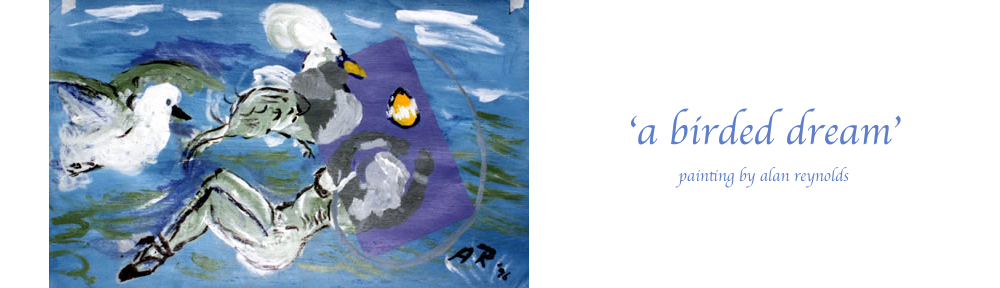

I.
Just bits you sell in passing as you fall.
Few SM fans extend to drilling teeth,
but you don’t stop. It seems to be your call-
ing. I command you: Stop. Come lay one wreath,
just one, to lay your longings out to rest.
They’ve run from dawn to vespers. There’s the bell.
You’re always in to put yourself to test,
but shadows lengthen. Longings likes yours dwell
too long in skulls like yours, and drive men mad.
El Cid would dream like you, but then would act –
while you but scream in slumber. If you had
his energy, you’d long ago have packed
your weapons, and have died in one last bout.
The theory: Go inside. Grab. Fetch it out.
II.
The theory (go inside, grab, fetch it out)
can soothe you. Save you. Try it here tonight.
I’ll help you practice, and, as one, we’ll rout
the demons who still make your smile too tight
when people who don’t know it talk of war.
You’ve learned well not to flare out these last years.
You simply walk away. You don’t get far.
When you look in the mirror I see tears.
You lock your heart when they laugh at lost lives,
and I applaud your stillness. Stoic. Sane.
But later, when you oil and whet your knives
and rust their hinges crying, you’re the bane
of my senescence. Come. It’s time to wrench.
Display it flayed upon the market bench.
III.
Display it flayed upon the market bench?
Yes. I’ll tell you what. Step down this way,
into our memories. Yes, that’s the finch.
The bigger boys had burned its beak away.
You would have killed them had you had a gun;
but thankfully we didn’t, and the brick
you broke upon one’s instep let us run
away to grow up. Yes, this is the trick
you learned in school of asking people Why
each time they talked of action. You’d oppose
with questions (better every year), defy
each thoughtless action. Still would, I suppose.
You like to lay your verbal traps about
and mark who flinches at your barker’s shout.
IV.
And mark who flinches at your barker’s shout.
Yes, you’re a barker. Biting’s not your style.
And war’s the weapon you would do without.
Turn the other cheek. Walk extra miles.
You don’t believe in that? What else is left
to you, who are convinced that evil grows
in ratio to righteousness of men
who shoot, but look no further for a rose,
or other reason, to be friends. When war
won us (well, lost us) – forced us to confront
the evils you had hated from afar –
you did your worst, effectively, to shunt
opponents to the Styx. You drench this stench:
this once was you. You sell it now to quench…
V.
This once was you. You sell it now to quench
a craving you developed (in those caves)
for being left alone. We ought to bed a winch
in the quarry (yours, mental), hoist those knaves
that taunt all your remaining summer nights.
Remember Spring? Colombia? You liked to sing,
and tease the colonel’s wife to shed her tights,
one of the pairs you’d parted with to wring
revenge from his, the colonel’s, side.
And all because you saw him maim that bird.
‘La vida’, as your actions broke his heart,
‘no vale nada.’ Courts found it absurd
that you were charged – and set you free to flood
your thirst for patronage, and theirs for blood.
VI.
Your thirst for patronage, and theirs for blood,
and that in northern cities for escape,
could make us rich. And better yet, it would
have done, you vigilante in a cape,
but you decided drugs could harm a child
and children, like small birds, should be set free.
Now action-tuned, you turned yourself loose. Wild.
You bombed the plane we guarded on the Key.
They would have killed us both. You got them first.
‘Off the offal’, was your crazy cry.
In many tongues you overfed this thirst,
became too facile helping others die.
When Roma called, you auctioned off your hate.
Note down who pays your price and hefts its weight.
VII.
Note down who pays your price and hefts its weight.
Our lives hang in the balance. Be alert.
You’re foreign here, like everywhere, and rate
a special sanction. Worse than death is hurt,
and hurt is what is driving our host’s plan.
You think his wife’s attractive, but it’s she
who urged his group to hire you. Over flan,
that follows goose and brandy, she’ll decree
how many ounces of your flesh they’ll chop
away in retribution for expenses
you’ve cost her family. As their profits drop
they cut their losses. Lost flesh recompenses
their pain. You use the knife, and hear the thud;
note how the drops behind them turn to mud.
VIII.
Note how the drops behind them turn to mud,
and turn, and tunnel. Down and down and down
to where the boatman waits. He lets you hud-
dle in the bilge, hide underneath the gown
the bishop gave for passage on the Styx.
Now we are here, and Death is here, and Life.
And something Else, that throws one die to fix
your pattern for the future. There is strife,
and stridency. Subterfuge, and, then, tender
remonstration. Candles light. We glide
away, no oars. A hand of unknown gender
takes yours, takes mine; it lifts us safe inside
an ancient hall. Tall monks expectorate
the little puffs of dust they wet, then wait.
IX.
The little puffs of dust they wet, then wait
to watch re-dry, grow up: stalagmite men.
Approaching you, these golems hesitate,
then strip you bare, and bind you fast with tin
and copper wires. You don’t resist. Your breath,
too shallow now to cloud a looking glass,
expires without a sound. You welcome Death.
You wait in vain. A score of hours pass
and Nothing happens; No-one’s here.
No human hand unbinds you, then you’re free.
You’re free, and hate no more, and birdsong clear
as God’s, or Julie Andrews’, do-re-mi
leads you to a window. Hold the sash
a while, for decency, before you dash.
X.
A while, for decency, before you dash,
isn’t long. You fear no golem’s hands,
or mob reprisals. Nothing makes you rash,
and singing birds suspend thin silken strands
to guide your steps as we stride from the cave
and out its mouth to glory. I shed tears,
but you are taciturn; you do not rave,
or get us into trouble. You’ve no fears.
No fears. No more. And also, no more hopes.
You sell your time as worker bon marché;
ignore the barks of meal dogs hanged from ropes.
You’re catatonic, want to stay that way.
You, once the warrior, let all battles pass –
to spend your income on a looking glass.
XI.
To spend your income on a looking glass
is motored by a very meager plan:
you want, here, after all that’s come to pass,
to check if you can see the inner man.
I find you can’t. To me I look the same,
and you (who’s that?) remain romantic, lost;
and little changed, in visage, from the game
you’ve played (played us) each time a coin was tossed,
and every time a birdcall called us out.
Your armor’s rusty, and you’ve lost your thrust.
It’s time to cut from battlefield to pout,
to sell out memoirs to the upper crust.
They’ve always had our soul. We need the cash,
to see if, now you’ve lost it, you look flash.
XII.
To see if now you’ve lost it you look flash
requires more money than a monk can muster.
The wage you earn retiring market trash,
a quarter what the major pays his duster,
is what we used to get through in an hour.
Use your skills and give your back a break;
I could use the money and a shower.
This city, and this world, are on the take;
but you, of all Earth’s fools best in the know,
persist with head down, hoeing with a rake.
Reciting lines like litanies, you go
through time entombed, with both feet on the brake.
Look then! Has your grace gone to higher class
or simply thinner? Thinking soon will pass.
XIII.
Or simply, thinner thinking soon will pass.
Fat chance you won’t give power one more whirl.
The mayor’s duster will not let his nas-
ty wishes shame her. Poor and stupid girl!
He calls this virgin, ‘Whore.’ What’s that, a sty?
Your eyelid twitches. Knife back in that sheath!
The mayor’s lynch friends vote to crucify
this righteous girl, then burn her, on the heath.
No, these are not just words. They really will.
It’s custom here; and you are garbage — low,
not lethal anymore. You will not kill,
though your inaction ushers in Hell’s glow.
Don’t let reason leave, to heed this call,
as did career and family. They are all.
XIV.
As did career and family. They are all
you ever had. God knows I miss them so.
You take the knife, the knives (the knives!) and haul
their edges over leather till they glow,
surprise the mayor’s henchmen cleaning guns –
surprise the mayor too, by striking low.
The river’s dark at noon down where it runs
beneath the heather bridge. The current’s slow,
and heartbeats stop. The bravest one is yours.
Yours starts again. The town makes you new mayor.
Of all you were, the little that endures,
the piece that works, is not the righteous slayer,
but the parts you flog, ignoring birds that call –
just bits you sell in passing, as you fall.
XV.
The theory? Go inside. Grab. Fetch it out.
Display it flayed upon the market bench,
and mark who flinches at your barker’s shout
this once was you. You sell it now to quench
your thirst for patronage, and theirs for blood.
Note down who pays your price and hefts its weight.
Note how the drops behind them turn to mud
the little puffs of dust they wet. Then wait,
a while, for decency, before you dash
to spend your income on a looking glass
to see if, now you’ve lost it, you look flash,
or simply thinner. Thinking soon will pass,
as did career and family. They are all –
just bits you sell in passing, as you fall.
Piece Work was published in ENVOI 126, June 2000. (ENVOI)
 Earth Tourist