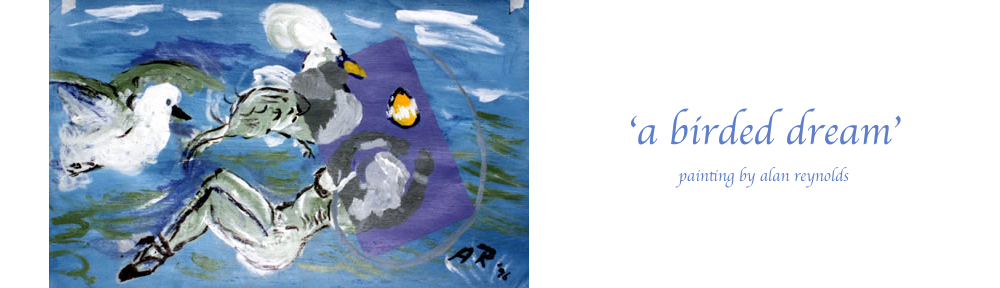
Out Doors Life

He stands at his window and looks at the snow
and the wolf tracks in front of his door.
He takes his new phone – there is no one he’ll phone –
and he makes photographs till he’s bored.
Then he sits at his desk, which is large and impressive,
and he wishes depressively dusk
would absolve him of actions which in the dark he can’t do,
but the morning has hours to go.
A bird whose black shadow was large as his desk,
when it flew over dropping those rocks,
which had scared him, seems smaller in the tree where it perches
and he stands up and pulls on more socks,
and a wool jacket weighed down with a Ruger Vaquero
in its holster he’s sewn in himself,
and a parka and gloves, and, finally, boots.
Then he genuflects, opens the door.

Street Bones in Spanish Hill Town

I swing
the olive doors’
square shutters — solid wood —
and winter sun runs in and squints
my eyes.

The men
who live up here
have driven off in cars
with rusting doors, to look for work.
I stay.

As stay
the old, the poor;
the gypsy woman who
has fourteen sons, makes baskets, and
who drinks.

Her black
crocheted crepe wool
old wrap protects the sun,
and children running down to school,
from her.

We use
the terrace roof
for breakfast and a lounge.
Not one of the indigenous
admits

he thinks
(she thinks, they think —
new verbs to conjugate)
that we’re less mad than rabid dogs
to sun.

I read
the news in Dutch
and practice Spanish verbs —
except on Tuesdays when I watch
TV.

I look
at CNN.
I need to when there’s war
but otherwise its tag lines make
me wince.

Down on
the dusty street
I sweep up scraps dogs strewed
outside our solid olive doors
last night.

The wind
blows every way
but not enough to shift
the salad left when night strays took
the bones.

The bag,
the plastic sack,
of roasted-chicken bones,
the scraps we hung up on the wall,
had split,

pulled down
by dogs, or cats,
who hunt the midnight streets
for food, by tearing pit-bound bags
apart.

At home
we worry that
a dog might choke on bones
from roasted chicken. Tell that here,
folks laugh.

Riparian Afternoon

How loud the blackbird sings
above this languid stream!
While unseen smaller birds respond,
an otter and I dream.

The otter on the other side,
and I here in my shade,
and flocks of tiny birds on rocks,
comprise the cast that’s made

this afternoon’s performance grand –
like that of yesterday –
and those of every day for aeons.
Sunlight and shadows play

at dancing, while the current dawdles
over ancient rocks.
Oh, everything is perfect here.
We have no need for clocks.

We have no need for anything
that is not with us here.
The blackbird and the otter see
the water’s clean and clear.

The shade that aids siestas
and the burbling creek sounds team
together, and we all unite,
and give thanks. Then we dream.

Languish Skulls

I am happiest where what I speak is foreign,
which is everywhere, increasingly, today,
My English suffers anguish from self-exile.
My French and Spanish languish, but get by
in situations where I’m buying something.
I’m told my grasp of spoken Dutch is perfect,
or were they telling me that I am deaf?
What’s next? Who knows? Habléis U Esperanto?

Homecoming

I can take you there today, if I can find it.
If I can get the key to the padlock on the chain.
You can hold the gate aside. I will drive through.
You click the padlock closed. You climb back in.
We drive across wild meadows where the road was.
We get out where the log bridge washed away.
We ford the creek, knee deep in rushing water.
Our clothes should dry out quickly in this sun
But here the path comes underneath the trees.

Reason Can Can

Here’s one that is more than and different from just a story. It feels more like a semi-abstract painting: if made clear like a photograph, it would lose its raison d’être.
Cold reason is an arid field of dust.
You can plough it daily.
The Good Lord knows I do.
More tears don’t trouble desert dirt.
Thats why I plough out here.
I work so long I get bone tired,
get tired of seeing blood on dirty hands.
A blister’s blood dries fast in desert air,
rusts gold and restful when the sun goes down.

Yes, we can can.

In the delta, blues are froggy, soggy wet.
Stay away, Lord. Stay way, way away.
A feral boar hog wanders in regret.
Loose music gets the dire, dry people tight.
They sing a song of ploughing dusty rows
in the desert where mirage is all that grows.
I plough the swamp, let in the drying sun.
I pack a pistol and a combat knife.
I am scared of nothing but my mortal self.

Yes, we can can.

Corriente Pimentón

corrient
I pause mid-river toeing for a rock.
The undertow unmans me. Tropic fish?
Although I bathe, I wish I wore a sock
or similar, to block against the swish
of Candiru. Perhaps a radar dish
antenna could, uh, foil his foul attack.
I swim strategically, float on my back.
‘Urethra! One has found me!’ shrieks my mate.
‘Piranhas leave you less you have to hack!’
His creepy shrieks persuade me not to wait

Paro no meio do rio, com o dedo, escavo areia.
A corrente me desveste de coragem masculina. Peixe tropical?
Mesmo que me banho eu desejo estar usando uma malha
ou similar, para bloquear contra o
Candiru. Talvez uma antena parabólica
poderia, uh, enganar seu ataque traiçoeiro.
Nado estrategicamente, flutuo sobre minhas costas.
‘Urethra! Um me encontrou!’ grita o amigo.
‘Piranhas deixam voce menos coisas para cortar!’
Seus gritos apavorados me convencem a não esperar.

Rosa S. Clement provided this translation to Portugese and this picture to accompany Corriente Pimentón’s (‘Chili-pepper Current’) guest appearance in August 1997 on her award-winning website A Moment for Poetry. Her current and even better website is at http://www.sumauma.net/amazonian/

SPELL OF SUMMER

This is the very best of times.
Green gardens ring with tingling chimes
of ice in tall drinks edged with lime.

The women wearing see-through clothes
wander pointedly unposed
in light sunglasses that disclose

a welcoming that seems to say
come hither more than go away.
There’s little stands in Cupid’s way.

The river’s bank invites, as fast
currents transport new-mown grass.
New lovers wonder will love last.

The winter’s sorrows fade away.
The cemetery’s lawns are gay
with small white flowers whose bouquet

preambles pleasures for these hours
when lovers pause between brief showers
to sun, and sample elfin powers

the summer serves. The lawn is warm
and beauty is a thin tanned arm
that, brushing mine, completes the charm.