I am counting out mai tais
In coffer sponges
Putatively by Tease Violet, Miss Quote of 1915.
Now to which Real Poet could this be owed (an ode?) <– (Shurly too easy. Ed.)
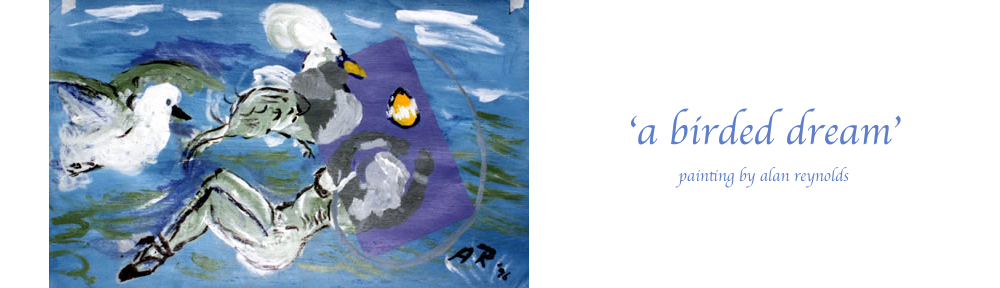
I am counting out mai tais
In coffer sponges
Putatively by Tease Violet, Miss Quote of 1915.
Now to which Real Poet could this be owed (an ode?) <– (Shurly too easy. Ed.)
Of his rugged good looks, senility and death
compete to pry away the final pieces.
He is finding life less precious these last days.
He’s become, he thinks, a contemplative species,
a sapien now it so little matters.
The tatters of his reputations count
less stridently each shrunken afternoon.
His latest prides and prejudices dismount,
and he, unhorsed and fearful of the sword
that he brandished for three decades and once used,
takes solace in the autumn sun that frightens
his face this spring, and he is sore amused
at the quandaries life presents him, such as death.
He shivers in the arctic breeze that splays
the sunlight into shards of frigid glory.
He is finding life more precious these first days.
seeks cars in toilet
barks, ‘buick, buick, buick!’
holding onto bowl
Callosa Bells
Users Manual,
Municipal Sound Media Time Measuring System
Chapter 1, Getting Started
Congratulations on your having chosen
to live here in our modern little town
where the city council’s wisely frozen
time itself in the plaza’s church’s crown
to help you order all your earthly hours
and, by implication, all your life.
Please read each chapter carefully to learn
how to get the most from hearing bells
whose two-and-seventy pleasant patterns
make more sense than many ever know.
Of the fourteen Ones all but two mean quarter past
and the second One’s precisely one o’clock
and the One two minutes later echoes that.
The Twos begin at thirty after midnight
and except for the fourth that comes at two-oh-two
the remaining twelve are markers for half hours
except the third one: it tolls two o’clock.
There are just two Five’s and the first is five o’clock
and the second follows it two minutes on.
First Eleven plays the hour before noon
and fifteen seconds after thirteenth Four.
The second Eleven plays two minutes later.
Of the fourteen Threes they’re two as you expect
reserved for chiming three o’clock. Yes, twice.
And the others; that is, not the fourth and fifth,
all share the meaning of a quarter to.
Most of the Ones, as you now know, are fifteen’s.
Most Twos are thirties, most Threes forty-five.
Some users are surprised to learn the score
of a dozen Fours is nothing; and they’re more
surprised to learn they’re also sixties, each
and every of these dozen Fours is live
with revolutionary zeal and endless means.
Which leave two Fours. It’s interesting the fifth
is the only number sandwiched in between
two of its own kind: the fourth Four and the sixth.
To guess two Tens should take as little art
as knowing they are minutes (two) apart.
Which leaves our hands at nothing or at Twelve
of which, it follows, there are only two,
one two minutes after every midnight
and one to close this system every noon.
The poem below is an example of a Particular Poetic Form, one in which someone somewhere will be all too pleased should its popularity be revived.
This form could be called ‘Verder en naar beneden, schreeuwde de werkloosheidsuitkeringsman met een glimlach’ but that is not its real name.
Its real and ancient name is “SE1 7NA” (from which it is but a two-minute walk to the Hole in the Wall, and a seventeen-minute walk back, or more if the Thames regains liquidity and rises). It is a Formal Particular Poetic Form, as are many of its ilk.
Every SE1 7NA consists of two and only two stanzas, each comprising ten lines in
the wrigid wrhyme pscheme a b c b c a d e d f
AND
where the ‘a’ lines (and only they) in each stanza rhyme with those in the other stanza.
I would say more about this form’s provenance but the modest example below give so many cues that saying more would be, if this word can be used here, prosaic.
How soon may we see an SE1 7NA from any of you, and where?
Pensive Pints in The Hole in The Wall
‘Onwards and downwards,’ cries the dole man with a smile.
We’re to the pub before he can evict us.
Now London spends more cooling down than heating
we recognize his smile: familiar rictus
that our mirrors show us moments we stop bleating.
The taxed smog blacks us as we stroll the mile
of solid waste that’s wafting pounds and scents
across what still was river in our youth
when smelling salts (old sailors?) and breath mints
sufficed to whet what we called appetites.
New billboards bellow slogans. Little guile
and lots of blatant lies. We feel at home.
Old oxymorons, some like ‘green’ and ‘peace’,
and newer ones, ‘invest’ and ‘catacomb’,
compete. We spend our money sent from Greece
as repayment for when we helped them out the while
they Trojan horsed us prophylactically.
In other words (a moment here of truth)
we’re as broke and busted as our Grecian ally.
We drink on tabs the way we do most nights.
people as totems
implausible totting-ups
takeaway leavings
world cup fantasies
orange hats and oranger dresses
out by the garbage
verbiage redundant
married longer than longing
best table near the window
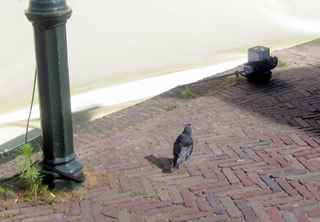
‘It is time we stopped taking walks together. Follow.’
The jackdaw knows we’re watched and is ashamed.
‘I don’t expect you’ll fly like show-off swallows,
but if we stay aground like this folks think I’m maimed.’

‘It is sad’, he adds, ‘that only in reflections,
like this one, can you reach the chimney tops.
If you’d better coordinate your genuflections
or hold you mouth right when you practice hops

we’d be the bee’s knees. Walk right on the edge
like I am, and, when I do, try to soar.’
Intent, I move from Hatch almost to Fledge
but chicken out, unfeathered, one time more.

‘There are few bipeds I’ve met with who are ground-leashed.
Are you an ostrich? You will get me ostracised’,
says the jackdaw sotto voce, adding, ‘Sheesh!’
I am fed up being walked and criticised

and I hope he’ll leave. He demonstrates a takeoff,
wings pitched to rise, and I call out, ‘Farewell’
but he pretends that I yelled ‘stroganoff ‘
and answers, ‘Where’s the beef?’ – he’s smart as hell
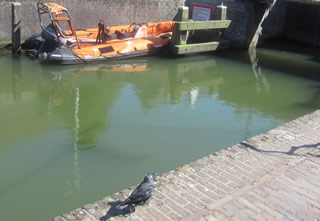
but a travesty as friend. He eyes a boat
and asks would I require a flying bridge
or an aeroplane to get across this moat.
I tell him blackbird pie is in the fridge,

and he says he’s et already and he alters
position getting set to cross the street.
‘Is walking something else at which you falter?’
says the jackdaw. ‘Now I’ll show you something neat.’

And he does. He crosses his path then takes mine.
When Jackdaw walks he walks with fire and flair.
‘Try this’, he says in parting. He’s so fine,
both feet at once stride neatly on thin air.
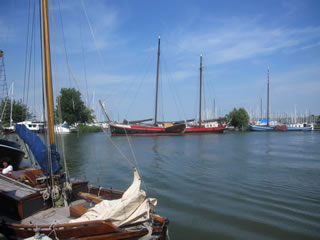
Finally summer, finely summer, and the sailboats
parade with purring motors past the quays,
meandering to berthings near the bridge
the harbour master raises on the hour.
Disembarking for an ice-cream or a shower,
the passengers abandon deck and bridge
for pubs and grillrooms harvesting these days
when no one needs a wrap or winter raincoat.
 Earth Tourist