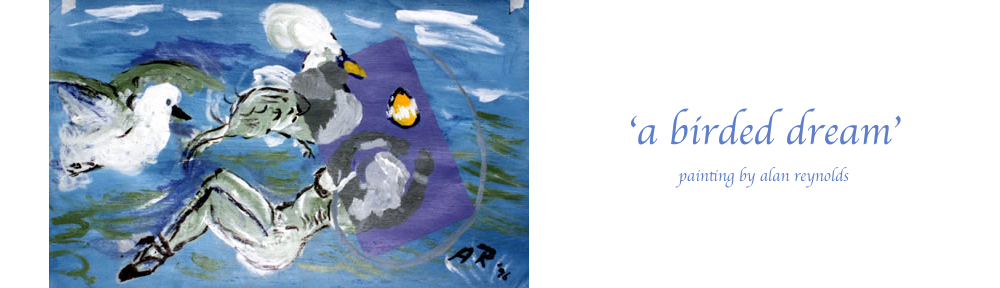
How Pleasant to Know Mr. Reynolds

by Alan Reynolds, with apologies to Edward Lear

How pleasant to know Mr. Reynolds
who has concreted reams of hot air
into harmless most times ornamentals
that he flogs for two cents at the Fair.

His mind is a sieve: he remembers
distortions of all that he hears.
He envisions an Earth burned to cinders
that he saves when he wiggles his ears.

For a human he’s an adept at flying,
say the jackdaws. They mean that he can’t.
He eschews every chance to die trying
and devotes his time trying to chant.

He basks by the sea when they let him,
not the jackdaws, the daemons of news.
He resolves every New Year to get trim
but that idea’s the first one he’ll lose.

His many friends number some humans,
several dogs, Evil Sam – that’s a cat,
and in Spain a matched span of ichneumons
he calls ‘mongeese’ and he chortles at that.

When he walks on the water it’s frozen.
When Earth welcomes in Springtime he sinks.
He’s averse to all lines that let prose in
and drifts off in those moments he thinks.

He thinks he would weep should the world stop,
he knows he will should it continue
to be wrung out by men like a whirled mop.
He imagines your gods are within you.

He reads, but he cannot speak, Spanish;
he mumbles hoping his listeners blame dentals
that he doesn’t need yet. Vowels vanish.
How pleasant to know Mr. Reynolds.

Hold Up

We must insist we never saw this photograph
even if we tell ourselves it is not real.

Having seen it sears our psyches with the thought
that absolutely nothing holds Earth up.
– – – –

We fall at speeds we cannot comprehend.
We circumnavigate the Earth while standing still
as it rotates at one thousand miles per hour.

Even that swift dash seems manageable compared
to how fast our Earth Rock gyres around the sun
on its eight-light-minutes leash: a thousand times
faster than our cars roll down our highways.

– – – – –
Thinking of ‘Pale Blue Dot’ — the photograph of planet Earth taken in 1990 by the Voyager 1 space probe from a distance of about 6 billion kilometers (3.7 billion miles, 40.5 AU), and of what Carl Sagan said about it.

Which Rock

They ask him one more time: Which Rock do you worship?
His answer chokes back when they draw their swords.
Not seeing them or him, girls walk small dogs.
A fly lights on his leg, points to one Rock.
A wave recedes and shows the Rock’s insignia.
Or was that shadow? He will get one guess
as to what’s accepted doctrine on this beach
so far from where he thought he’d started out.

He sees sky above the clouds above the swords.

Women washing windows of the restaurant
see him but not the fly. They see walking girls.
They see tiny jacketed dogs. They don’t see the men:
the men in mohair robes who point bronze swords
at approximately where he’s been told that his heart is
or was before he lost it on this beach
to a girl who walked small dogs that disappeared
when the tide rose and the brave Rocks in the shallows
became hidden, serving only to sink boats
like his that time he sailed here on his own
which is how he’s ending up. He hears, Which Rock?

Morning Menagerie

Sitting still enough that the mosquitoes cannot see me,
I watch dark birds commuting to the shore.
Consoled by Feynman’s father as to bird names,
I dub their species Mini-Nevermore
and think, had I the Latin and were first,
there would be many mini-nevermores in books.
The more I see of them, the more like jackdaws
my mini-nevermores appear, or rooks.
Ignored by bird and bug, I cogitate
which species I address compiling stats,
suspecting it’s the one that cannot fly
but does name dogs not knowing names of cats.

Consoled by Feynman’s father as to bird names alludes to my favourite Richard Feynman story, as he told it:
‘The next Monday, when the fathers were all back at work, we kids were playing in a field. One kid says to me, “See that bird? What kind of bird is that?” I said, “I haven’t the slightest idea what kind of a bird it is.” He says, “It’s a brown-throated thrush. Your father doesn’t teach you anything!” But it was the opposite. He had already taught me: “See that bird?” he says. “It’s a Spencer’s warbler.” (I knew he didn’t know the real name.) “Well, in Italian, it’s a Chutto Lapittida. In Portuguese, it’s a Bom da Peida. In Chinese, it’s a Chung-long-tah, and in Japanese, it’s a Katano Tekeda. You can know the name of that bird in all the languages of the world, but when you’re finished, you’ll know absolutely nothing whatever about the bird. You’ll only know about humans in different places, and what they call the bird. So let’s look at the bird and see what it’s doing—that’s what counts.” (I learned very early the difference between knowing the name of something and knowing something.)’

Jack Daw Declines My Invitation

‘It’s too early,’ says the jackdaw. ‘I’m not an owl 🦉’
He speaks on our private channel. ‘It’s the hour,’
he adds, ‘for roosting. Down there stray cats 🐱 yowl.
With my flock I’m safe here in the Great Church tower
and I plan to stay that way. No need to fly afoul
of whatever waits in darkness to devour
us avians who are taught to do what’s right.
Goodnight again. I’ll call you at first light.’