Nine Days to Silence – Day One

I retreat a final time back to The Farm.
I cross the creek down where the real road ends.
I walk from there, into the ever woods.
I ford the creek twice more and see the sun.
It cooks the dew from what had been the orchard.
The path is steeper than I had remembered.
A blacksnake on an overhanging rock
conceals her rapt astonishment if any.

Back into the dark forest. Does it end?
I work to think of nothing but I remember:
projects well begun but then abandoned,
salt traces on the cheek of one I loved.
The sun again. I step into the clearing
remembering it was here I learned to ride
with hope and halter, quirt and bit forbidden.
I used a blanket for a saddle on hot days.

Emotions I thought atrophied propel me
uphill to where the cabin’s rough-plank porch
was the perch I launched myself from in the dawn
before walking through the weeds that wet bare feet
to wade the creek and watch for rainbow trout
that faced upstream below the larger rocks.
On nearing, I see saplings, dirt, and weeds.
The cabin I planned to move into is gone.

Time Fall

We take time to contemplate the universe,
our approaching sleep embraced by alien arms.
Is our galaxy avoiding the void?
How many super galaxies underpin
the nothingness on which all matter rests?
I fall asleep while you count falling stars.

I wake once more on our planet on the edge
of falling while revolving round a star
that itself is falling casually in step
with myriads and plethoras, and with slews
of things and forces I don’t understand.
Not that it matters as the fall continues.

Hades

We fall into silence and through it
to end up with rib-cracking sighs
the size of a minnow or an inner
tube connecting the cosmos to sin.

We grunt as we board the boats shunting
the bodies of the people we were
to the other side widely imagined
as resembling a permanent state

of stasis in motion, a notion
hard to swallow now we are au fait.

‘I pass'd, methought, the melancholy flood,
With that sour ferryman which poets write of,
Unto the kingdom of perpetual night.’
― William Shakespeare, Richard the Third, I. iv.

Electric Ballet

When Nathalie, the dancer, asked me out
I envisioned somewhere sweating in a gym.
She said that, no (she spiced ‘no’ with a pout)
she meant this time a fête she’s giving Clem.
She looked so pert, so powerful yet slim,
I knew this was no offer to disdain.
Such fey good looks, so go-ahead and trim:
perhaps it’s posh to be balletomane.

Arriving at her house in stylish Zuid
I plunge into its hall. The lights are dim
and ballerinas stand en pointe to scout
for Clem’s arrival. Suddenly heads swim,
as he comes through the door. The brothers Grimm
would suffer glottal stops, he’s so urbane.
Accepting the hostess’s kiss, Clem’s stance is prim;
perhaps it’s posh to be balletomane.

Their seriatim shuffling mounts to rout
when the would-be divas spot Clem’s turned-out limb.
Host Nathalie espies a chance to flout
the plans she sees them plot to annex him:
To stymie staging for her diadem
she choreographs him by me. This constrains
the ponytails from roping Clem with vim.
Perhaps it’s posh to be balletomane.

This evening I’m too suave to ask, ‘Who’s Clem?’
(more gauche than ‘Elvis who?’ or ‘What’s cocaine?’)
With feet croisée and arms en haute I skim.
Perhaps it’s posh to be balletomane.


The room is warm and, wishing for a drink,
I ask old Clem, ‘What’s your atomic weight?’
He laughs out loud at this daft thought. I think,
‘At last! Here’s hope for fun at any rate.
If we’re to bate our boredom why not bait
a hook with slice of new clear fizz? Begrime
night’s visage with a fillip. What’s one? Wait:
‘Electrons moving back through troubled time.’

I tell a fable: the atomic rink,
fey place where observations calibrate
the rays and darks, and flavour quarks. This kink
appeals, send Clem’s brows up to browse his pate.
He asks the eager girls to illustrate
by dancing as he bongs upon a chime
and we both chant how positrons relate:
electrons moving back through troubled time.

Lord, how they dance! The blonde stands on the sink
and galaxies attend her whirls, debate
with worlds unborn till divas’ lashes blink
and call them forth to glory. This is a fête
like none canals have seen: we postulate
the theorems, then they dance them. Grace! Sublime
small sparks are born, then gyrate off and mate
electrons moving back through troubled time.

Dear Hostess, note the exhaustion of our state
and bring fresh grape to boost the bold enzyme
that kicks our progress up to Kali rate:
electrons moving back through troubled time.

Zuid (literal translation south) is a fashionable residential area
in Amsterdam.
Red Horse Dancing

The red horse dances hours in the sun
rehearsing two steps left, a bow, a stretch.
Three wading birds make no tracks as they walk
across dried mud. It’s hot in the Camargue.
I take the heat and watch the dancing horse.
The horse nor I will try to ford the mud.

There’s no one here, forever, in this heat.

Flamingos wade the water, browsing gunk,
and muskrats gnaw the cane grass. I am home.
‘The Black Book’ — Durrell’s premier published work —
lies where I dropped it, Tarquin’s tortured ‘lorve’
no match for red-horse dancing. Egrets fly
around flamingos, muskrats, horse and me.

I think how Durrell’s ‘Quinx’ taught me the tales
that brought me to this flat and open space:
gypsies in Les Saintes Maries de la Mer.
That town’s now filled with tourists, but out here
the red horse dances. Alan has come home.

I saw this horse, free and loose (across the mud flat of the Mudflat Bat), dancing by himself for at least an hour. I’m couldn’t really stay there forever, although I was tempted. I don’t think you can be home in any one place when you are an Earth Tourist.

Mudflat Bat

The crescent moon hangs south, above the sea.
Out here in the Camargue the mud-flat bat
flies higher now. The atmosphere, you see,
has lightened. Insects lift, ensuring that
the mud-flat bat’s own mouth and mine won’t splat.
He flew so low on Wednesday that I feared
I’d swallow him in darkness, furry-eared
and sonaring the night. It scared him too.
Mosquitoes, the ones who Wednesday rudely jeered,
become his meal, malaria his stew.

Another ‘postcard’ — this one from the Camargue, a place of magic for me and part of the marshy delta where the Rhône river spreads out south of Avignon. In July the Camargue is hot and as dry as Arizona; in the winter two-thirds of it is underwater, sometimes only a few centimetres deep. I wrote this there one night, two miles north of the Mediterranean, standing out on a mudflat edge watching this particular bat inveigling me to write about him, or to open my mouth.

Lemon Hill

The poor and lame climb up this hill when the fruit begins to grow.
The going blind watch from the shade and squint at April’s glow.
When flowers finish blooming and the rain pails them away,
petals pour down darkling hills and pollen swims the bay.
In May the buds begin to swell, accelerate their slow
chill winter’s start and form gold orbs absorbing sun in rows.

June’s sun bakes shade from leafy trees where turgid spiders spin
the webs they lime to catch their prey that had its own chance when
down in the roots the fly-nests blew, and the buzz that blind men hate
teased sighted heads as flies laid eggs in eyes, to incubate.
July sees owners mend the wires delineating groves
and joke with wide-eyed pickers who’re returning here in droves.

The healthy climbers harvest two to the blind or cripple’s one
as all hands strive together in the sweltering August sun.
Hands reach up where the branches fork, and arms stretch down to throw
ripe lemons in reed baskets with a braggadocio
that helps them harvest money now, to live on when it’s slow
and dulled eyes shine reflecting back when fruit began to grow.

© Alan Reynolds. Published in THE ARMCHAIR AESTHETE, Issue 16, Summer, 2001, New York.
Having taken a ferry from an island to the Greek mainland, we cycled uphill to a lemon grove exuding a fragrance I thought literally ‘heavenly’ in a place that was an antonym of ‘haven.’ Half-starved cats, more semi-persecuted scavengers than pets, wandered among people suffering from white-eyed blindness that I guessed, perhaps correctly, came from blow-flies. And heptameter meter ‘chose me’ to try to portray the strange mix of richly fruiting trees with heat-stilled inhabitants.

Les Uns et Les Autres

Les Uns et Les Autres

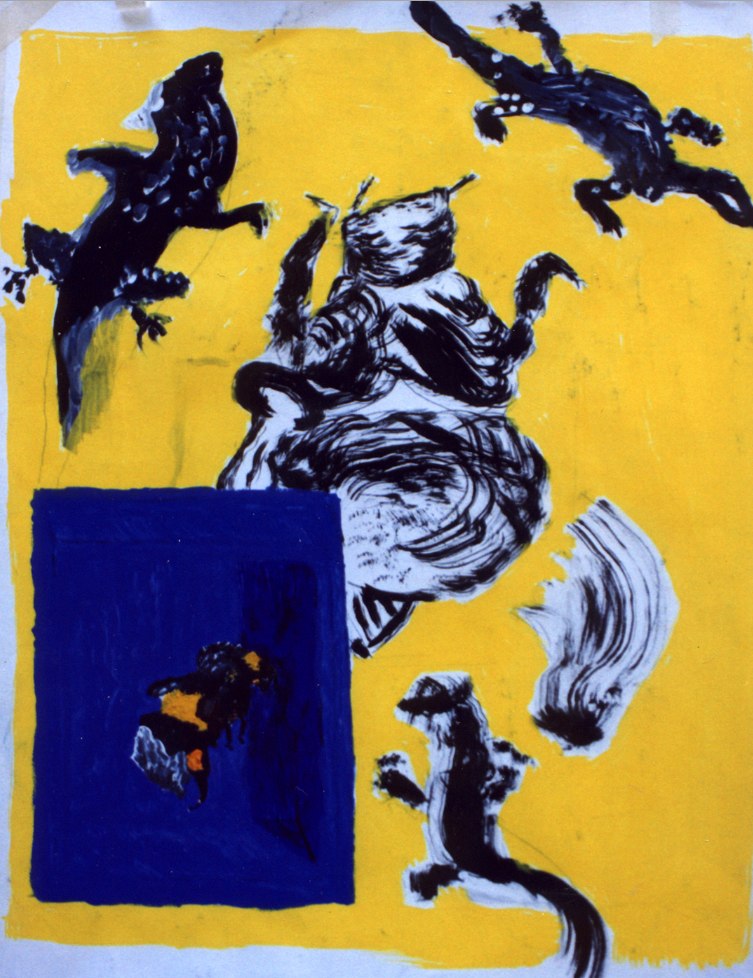
Alan Reynolds, acrylic on paper

These rough-drawn salamanders symbolise
the patient grace of Gaia as she pours
our molecules, in always-new reprise
of forms and folds and patterns she adores.

This bee, who’s dead, or sleeping in this box,
epitomises Gaia’s gayer pranks.
He’s sniffed the flowers, flown above the flocks
of sheep in April; gambolled near their flanks.

He bet he’d last the summer, and he might,
but only on this canvas, stretched and sketched.
Perhaps he’ll be recycled as raw light.
A full reincarnation? Too farfetched.

We dance in patterns we cannot perceive
but Gaia does, and pets us when we grieve.

Originally a 19th century silkworm nursery, the now legendary artists’ retreat ‘Beauregard’ in southern France nestled among vineyards, forests and Celtic ruins. It was where the artist Leo Musch (1943 — 2013) gave wonderful summer lessons, inspiration, and lodging to painters and sculptors.
One July morning Leo assigned a project where we were to paint something showing motion whilst leaving an empty rectangle somewhere in our paintings. He would tell us later how to use the rectangle. I covered my large sheet of gesso-treated paper with acrylic sketches of some lizards I watched playing, and of a bumble bee that fell and lay still on a table where I had been having coffee under the trees. I carried the bee around with me in a metal box, feeling he might have been sent to me as a model. Leo reviewed the pictures and instructed us to make different but related paintings in the reserved rectangles, showing some theme that would relate the two parts of the work. I sketched the bee (about twenty times) on other paper, then painted him in the rectangle, in a three-dimensional box that looked out into other space and time. Then I wrote ‘Les Uns et Les Autres’ to accompany my painting.