Christmas Eve Again, Thank God

All the stores close their registers, bolt their glass doors.
All the shoppers go home, except one who explores
the car park for hoof prints, for he’s hoping to find
the traces of reindeer. They have left him behind.

He’d stopped for one eggnog, and he had the worst luck,
for who should be sitting in the Feather and Duck?
His mate from the Navy, drinking sloe gin and lime.
They ranted old chanteys and he lost track of time.
They rejigged the hornpipe then they spliced the main brace.
As dusk came his buddy fell flat on his face.

He’d paid both their tabs from his good buddy’s cash,
left a note in his vest, ‘Don’t go throw up the sash.’
Now amok in the car park, casting light with his nose,
he attracts folks’ attention. They notice his clothes,
his felt-padded belly, fin de siècle high boots.
‘Hey, dude, you and Batman, are you two in cahoots?’

Déjà vu thoughts, history that’s happened before,
make him run to a diner, make him pound on its door.
‘Let me in. You will like me, for giving’s my bag.’

‘Come in, Hansel.’ His greeter’s a grotty old hag
who jerks him inside, saying, ‘You’re safe here from harm.
Oh, I so loved your sister, especially her arm.’

As gingerly, quietly, he breaks from her grip
to go dash up her chimney, surprised at his clip,
he notes he’s so agile it must be a gift.

‘Gift’ causes him panic as his redlined mind shifts
to the job he’s been trusted with: flying the skies
bringing presents to children. ‘My reindeer!’ he cries.
‘They’ve deserted me sadly. This evening will go
to the dogs like some royals I press-release know.
To the pits like some pols who this year gained their fat
by skinning poor peasants and avoiding the VAT.
I’m running on empty while the men who run guns
pay for adverts portraying them as better than nuns.
The guardians of Gaia have lost every round
this year to consumers, while sly pundits have found
silver linings invented to draw oohs and ahhs
from the rabble (that’s me) who could care less because
we can’t find clear targets for to focus our rage
and beliefs are derided. Pedestrian age!’

As his cri de cœur echoes through uncaring streets
an angel approaches, bearing kindness and sweets.
She embraces the sad man: ‘You’re muddled and lost.
All the chances we’ve sent you are toys you’ve tossed
from your crib into the river. You’ve tried not to soar.
You’re a raving lost tot. Never mind ‘never more.’
Here’s a new chance for Christmas (its meaning, you know).
Here’s a sleigh, brand new reindeer, and a leg up. Now go.
To the top of your courage, to the end of the mall,
to the places you dream of. I will let you fall,
but I won’t let it hurt you the grey, deadly way
that not caring shells you. Go out now, and play.’

As his angel departs him, he straightens his spine,
then whistles his eight deer, perhaps they are nine.
‘It’s Christmas, me hearties, and we’re ready for flight.
Merry Christmas to all, and to all a good night!’

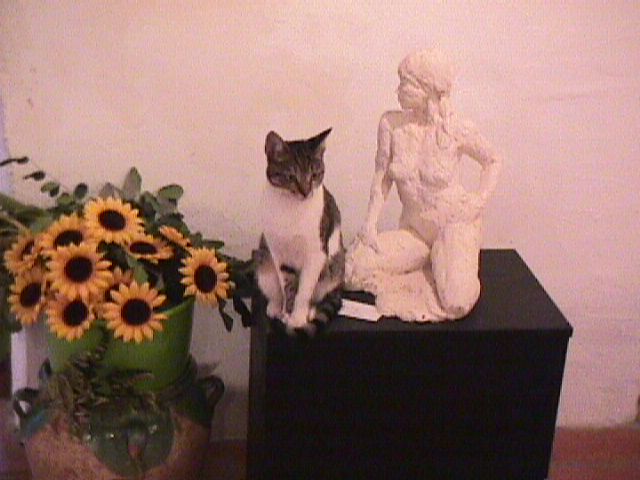
The Cats Sam and Meg

Sam

Sam explains to me there is a concave mirror
in the base of the sun that concentrates
the rays from the larger lighter moon
to warm our hours when the moon’s asleep.

I ask Sam about his sister
and he switches and twitches
his tail and the light in his
eyes is not Mercy.

Meg

The elections of yesterday
have gone unreported
among the almond trees.
I drop the twigs and sticks
upon the growing pile
and would light it
had I matches.

I have the Gaelic
but only in boxes
not near enough my tongue.

Samuel is good at ellipses
but Meg, his sister, excels.
She says volumes with each
silence, and cares
little that no sheep
partake of grass among
the goats.

‘Don’t blacken me with pot,’
I say to Sam.

Meg pretends to listen
but her ears are on
other frequencies
and spiders are unsafe.Meg is hunting moths tonight,
leaping at nothing in the dark
and returning with munchies.
I hear her chew them but
I did not hear her land.

Being Alive at Ninety-One Rue de Sabrosa

A bit of ‘wild mind’* writing for a friend

There are squirrels in the fall-fashion colour called ‘mauve iridescent’
and a jackdaw as witness or he would be were he not sleeping.
The frail-seeming Goddess turns over and aeons collide
as she sleeps in the forest in a bag of impervious silk.

The prices one pays for being alive at Ninety-One
Rue de Sabrosa! ‘What’s a Sabrosa?’ asks a Jung gull,
collective memory awry at Avian Heights.
‘It’s a street name,’ answers uselessly a management consultant
who is also an owl who also may moonlight as mouser.

My world is a far better place with you in it.

The silk bag hovers nefariously (‘Precariously?’
asks the Jung gull) in spite of supporting the goddess
and serving as the perch of the great horned owl.
‘Horn-rimmed,’ suggests the Jung gull. ‘Stop that. Owl!’

We wished for rain and got some, built an ark,
ensured it All-Risk. When it washed away
we were in clover until the sky went dark,
the stars going out. We miss the milky way
that horizons used to glimmer. The sky’s gone sour
and bobs your uncle along with green crab apples.

‘More drink?’ the dormouse offers. It won’t help.

Wild mind – what else? Tame kidneys? Placid lungs?
Mythology is a giggle when compared
to this Jacob’s ladder with its missing rungs
sawed off – I’ll bet – by the goddess who repaired –
she says – the galaxy that we turned into plastic.

A multiple-choice quiz defeats the purpose
if there was one of a proper education.

She is not hungry so she eats a second breakfast
to kickstart resurrection but that fails.

‘Wild mind, why not? I’ll tell you,’ says the editor.
‘Writing on is a plague like overpopulation
and,’ he adds theatrically, ‘pervasive plastic.’

The lame life story lies down with short lines
that consume it but by gods not soon enough.
Vinegar recesses – wine, grapes, vines –
to primeval algae, dustbowl. Quantum stuff.

We watch creation wind up, stop, rewind.
A thousand thoughts escape and wave goodbye.
Good riddance too. We think they are unkind
and they say we are dull. Okay, goodbye.

The plethora of totality are one.

  • A footnote about where ‘wild mind’ came from. As I scribbled along I remembered ‘wild mind’ from a book I read in August 1999, Wild Mind, Living the Writer’s Life, Natalie Goldberg, 1990. Quoting her in part: ‘… I want you to look up at the sky. Do you see it? It is a big sky … So our job as writers is not to diddle around our whole lives in the dot but to take one big step out of it and sink into the big sky and write from there. Let everything run through us and grab as much as we can of it with a pen and paper. Let yourself live in something that is already rightfully yours … your own wild mind…’

Game of Words

I play with words the way rulers play with lives.
I elevate some of them, and I set others
against each other, slashing as if knives
were what they were. If I find a word that smothers
the others in my word menagerie
I snuff it out the way rulers do with lives.

Unlike with shamans, presidents, and tzars,
my powers do my subjects little harm.
When I am dead and done for, words will be
in dictionaries alphabetically,
and locked in novels, and free in open minds,
and floating between planets while they wait
for future speakers to provide them breath.

When shamans shame a person to go fight,
when presidents preside and send in troops,
and when tzars drive cars across their peasants’ heads
the people they run down stay grievously dead.

I can’t know if I am more moral than all world leaders,
but fortunately I am weaker, and I use words
as my objects for tormenting. Words can’t die.

The powerful trick or force the weak to work
on things that make the powerful more strong.
The strong earn billions (‘earn’ is here misused)
off the backs and dreams of people with less power.

I play a game with words, but those I exploit
remain as well off as do those I don’t.
To rulers causing torment, words are a quoit
they throw to ring in dissidents who won’t
kow-tow to them. Let them throw rings of iron
as often as they like till they expire,
these rulers, who like us must grievously die,
but our words and word games will survive their worst.

The Poets’ Dilemma

A cri de coeur can’t be a work of art.
Its zealousness drives sense away, sends rhyme
to moon at June and here (forgive me) ‘heart.’
From paucity, some poets may try on ‘clime.’
Aboard the wagons of the criers’ band,
the preacher’s prattle petrifies the mind
that tries to get away with sleight of hand.
We throw away the melon, serve the rind
whenever we press thoughts down for the counts.
We, Honest Poets, are prone to masquerade,
expose our raison d’être in petty flounce,
and lose an audience we quickly jade.
We could express ourselves in prose that’s terse,
but then we’d be believed, and that is worse.

The Poet’s Dilemma read by Peter Crofton Sleigh:

Grammar Rules OK

It is almost midnight. She reads rules of Spanish grammar
in Dutch. This lets her fall almost asleep
until she wonders, what rhymes with ‘soporific’
and her mind’s off to the races. Ballads clash
with terse short-footed lines
in epics she remembers or might write
a dozen times again, each time forgetting
that she needs the sleep that’s purchased with the boredom
she can only find in studying grammar rules.