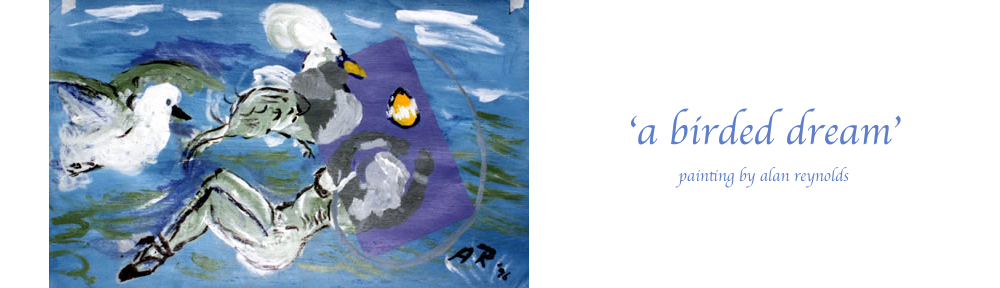
Occasional Guides

You have seen the open road of life
And how it drove us together
And what it did.

Dogs loose leashes, lose lives
Chasing life’s pleasures
Across roads.

Your wolfhounds, melancholy,
Gaze at life’s rabbits,
Electrical implants

And invisible tripwires
Keeping them immortal
Until blackout.
—————

You think I continue appreciating
Your forever improving me
But I cannot.

The fires of passion burn forever
Exalting those inflamed
But not here

Where you polished time until
It gave up passing
And stood down.
—————

God, a slow writer for readers on speed,
Lights wires they have tripped,
Proclaiming laws

Self-evident should corpses read
Or the quick acquire
Infrared.
—————

Beyond time space is pointless.
I imagine this no way.
It works.

A heron and donkey barter nests
They eat or sleep in
While I dream.
—————

God fell on hard times
And consumed them.
The residue,

Less than the wafting ash of Gomorrah,
Had no atmosphere
To waft in.

My starship, startled by this
Information from
Black holes,

Changes course one-tenth and tithes
Three years of Hawking drive
Reversed.
—————

If God is in the details,
Then seeing them is where
Satan lives.

‘Blessed vision’ does not mean
Seeing many of them
All at once.

And knowing that what goes round,
Et cetera, can drive
Someone once sane

To where despair seems kindness
And sanity is mockery
Of the dark.
—————

My starship is quicker than time.
Light loses out.
I am its crew.

Starboard is on every side.
Why do you regret
That I am gone?
—————

There were momentous eternities
We squandered gaily
Which is the way

To deal on that plane
Where tripwires are
Invisible.

Of course you cannot phone
Me here because
I’m there.
—————

Earth, out of the orbit
Of God and higher meaning,
Meant home.

We headed there, crossing roads
And invisible tripwires
With but

Occasional twinges and tears
We took for nostalgia
As guides.

God beat us home
Where even your care
Had gone.

Mad Helmut’s Tea Party

Bloomsday. Today. The 16th of June, the date (in 1904) that James Joyce chose to let his character Leopold Bloom start out in UYLSSES. One word encountered in that book — ‘hyperborean’ — stirred up the Durac and the Slynog to celebrate at Mad Helmut’s Tea Party.

Mad Helmut’s Tea Party

‘I’m hyperborean as much as you’ Buck Mulligan to Stephen Dedalus in James Joyce’s ULYSSES

‘Compared to you I am much more hyperborean’,

said the Slynog. ‘I am also mad for tea.

While you, my addled, fat, and calm historian

remain inert, a late-lunch parolee

as like as not to be an absentee

when North winds blow up harder, heeling ship

away from where there’s harbour, landing strip

and tipples bar.’ The Durac rose and shrugged.

It heaved the anchor, gave the waves the slip,

and pointed to the shoreline their boat hugged.

‘Hypoborean I may be,’ the Durac said.

‘If that’s a word. You steer boats by their wake

and were you our navigator we’d be dead.

So slur on, Slynog. Don’t make the mistake

of thinking finding home’s a piece of cake.’

Together the companions hoisted sail.

Together they turned green, hung oar the rail.

The North winds blew, the duo turning blue

and blowing kisses to disgusted terns

they sailed strait home by way of Timbuktu.

In Memoriam

Nothing holds its own today.
Death that lurked has come and gone.
One more spirit taking flight,
one less left to share this song.

Clocks wind down and no one cares.
In the noon sun I see night.
Strange how nothing live prepares
you for a soul that’s taken flight.

People group around and grope
for the right words to explain
how time will heal the hell they know
nothing is the same again.

Can you hear me where you’ve gone?
There’s no answer anywhere.
Not a note. Just rain descending
and the feeling that you care.

Brief Shining Moment

Life’s brevity extends another day.
A blackbird sings a brilliant hymn to spring.
Beside the burbling stream young otters play.
Trees bud new leaves, and almost everything
takes joy and magnifies it. Life is good.
Here, liveliest of all, a human child
dances lightly as the gods had known she would.
They count her days. She won’t, not for a while.

Bird Creek Summer

I was five and able still to float slightly above the ground when I ran hard, especially downstream over the big rocks in “Cottonmouth Moccasin” Creek. He was the biggest man in the world, my Grand Father. Took me all over that wilderness farm to show me bugs, birch trees and bird song. Yes, you can see bird song, with your eyes shut so tight that the remembered sun looks purple.
Grandfather, still strong, stout and sturdy at seventy-four, taught me how to see, and saw again through my eyes too. We were a pair that summer. “It’s Bird Creek,” he told me. “Don’t exaggerate its name just because you saw one snake and asked me what it was and I told you.”
Going up Bird Creek we both took our shoes off; he carried them, and waded right up the middle, splashing well away from the banks where there had been but the one snake. “A little waterfall,” he said. I said it’s awfully big. “Just always hold on somewhere,” he said, and we climbed right up in no time, him right behind me, carrying our shoes and his hoe.
Trees, mostly hardwoods, some pine, no poison ivy here, and almost no sun: the creek banks a crawling crevice topped by — what? Too far up to see from here.
Hours passed! “One hour,” he told me. We climbed the lower ridge. Below us lay the orchard. I know where we are! “That’s good,” he said. “Let’s go.”
Ranging the rough ridge: much sun here, weeds, grass, a million bugs. “Perhaps,” he said. “Stay on the trail; I think I smell lunch.” I ran ahead then fell behind. I read a spider’s web. Grandfather trod, plodded on, the hoe in his right hand. We could almost see the cabin when his hoe stirred a nest of bees.
They swarmed up, yellow jackets circling looking for a villain just as I got caught up, caught first stings and squealed. Jumped high for someone twice my height and almost really flew down the ridge looking for sanctuary and Grandmother.
Many, many, many leaps further on, a few, I looked back for Grandfather. He stood there in the swarm, his warm denim overall jacket over-decorated with all the yellow jackets except those on his hands and face and hoe. Laughing a big laugh that scared birds, startled deer and made the creek rocks smile.
Still laughing, he helped me cross Bird Creek, put on my shoes and stop crying. “Stop that,” he said. I did. He was still laughing when Grandmother rushed out, hugged me, made a tobacco paste and put in on my stings. Still laughing at lunch.

Nothing in Particular

Watching my my twenty-something thousandth sunrise,
Not that I have personally seen them all,
Having ceded some to clouds external and internal
Or simply from being asleep at the switch
From night to day
I rejoice with a mildness appropriate to
Septuagenarians settled by semi-centuries
Of taking lives as they come
Not that I ever have
Two seagulls fly over
Golden sun-rays beneath their wings
Lifting my spirits. I pour tea.

Morning Miracle

It’s predawn, and the wood doves are silent.
The sun slumbers under the sea.
One blackbird sings achingly sweetly
diluting the darkness with zeal.
Further off, past the sound of the breakers,
first light limns the edge of the world.
The wood doves and we and the blackbird
are witnesses: sunrise is grand.

BILLBOARDS

Cynic admonishes:
‘When you wish upon a star
you bet on something that’s too far
away to pay attention to
something minuscule as you.’

Stellar response:
‘Don’t underrate the speed of light.
We’re here for you day and night.
Pay no heed to cynics who
try to tarnish hope for you.’

Cynic sneers:
‘Ooh, silver linings! What comes next,
peaks with clouds up to their necks
who divert from mountainous tasks
to help poor you because you ask?’

Stellar response:
‘To believe in only what you see
blinds you to reality.
Once you’re wise you will perceive
that seeing starts when you believe.’