
Best Words for Species Speeds
2
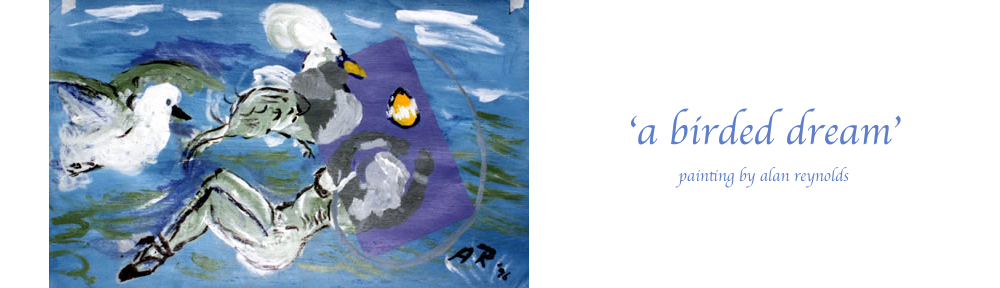
‘You must believe enough to kill, or else
it’s not a faith with content you profess.’
He praised his gods and roasted flesh and bones
of passers-by the odds had sent his way.
‘Pass-over bread’ he called the grim meal ground
from pilgrims shriven, freed of soul and baked
to slake the hunger of his tribe. They lived
among us not so long ago, his tribe;
in fact, their ways instruct us still: we kill
for oil, and other reasons we invent
to justify existence, on the wayside, in our tent.
‘I differ. I refuse to live that way,’
my Esther tells me, angry-eyed in Ghent
abhorring all the gore that’s eulogised
in this cathedral’s stained glass panes. Yes, ‘stained,’
a word that’s perfect to explain the tales
these windows glorify, these escapades
of lopping limbs for Lords that favour blood
to irrigate paths to the Holy Grail.
We call them High Crusades on Holy Days
and glorify their crimes in history books. ‘That’s wrong,’
my Esther tells me fiercely, ‘we’re not like that anymore.’
We cared enough to kill still in Kuwait,
with rockets, rifles, flames: bulldozers shoved
hot sand and buried boys stashed far from home
in ditches they hand-dug to stop our tanks.
I’m sure somewhere some parson offered thanks
to Mammon—or gods with modern names
whom we invent to take our garbage out.
‘You said we should!’ My troops are sick with rage.
‘You said Hussein must fall—whatever cost,
or else, like Hitler, he would kill us all.’
‘Of course I did,’ I answer, from the wayside, in my tent.

First published in ENVOI 126 (2000)—one of Britain’s longest-running independent poetry journals—Piece Work tells the story of a man caught between his longing for peace and the compulsion to act violently. Written as a sonnet redoublé, a rare form of fifteen interlinked sonnets, it explores the looping logic of trauma, conscience, and the voices that urge us toward action—whether just or not. Is one man speaking to another, or reasoning with himself? The poem leaves the answer deliberately unstable.
I
Just bits you sell in passing as you fall.
Few SM fans extend to drilling teeth,
but you don’t stop. It seems to be your call-
ing. I command you: Stop. Come lay one wreath,
just one, to lay your longings out to rest.
They’ve run from dawn to vespers. There’s the bell.
You’re always in to put yourself to test,
but shadows lengthen. Longings likes yours dwell
too long in skulls like yours, and drive men mad.
El Cid would dream like you, but then would act—
while you but scream in slumber. If you had
his energy, you’d long ago have packed
your weapons, and have died in one last bout.
The theory: Go inside. Grab. Fetch it out.
II
The theory (go inside, grab, fetch it out)
can soothe you. Save you. Try it here tonight.
I’ll help you practice, and, as one, we’ll rout
the demons who still make your smile too tight
when people who don’t know it talk of war.
You’ve learned well not to flare out these last years.
You simply walk away. You don’t get far.
When you look in the mirror I see tears.
You lock your heart when they laugh at lost lives,
and I applaud your stillness. Stoic. Sane.
But later, when you oil and whet your knives
and rust their hinges crying, you’re the bane
of my senescence. Come. It’s time to wrench.
Display it flayed upon the market bench.
III
Display it flayed upon the market bench?
Yes. I’ll tell you what. Step down this way,
into our memories. Yes, that’s the finch.
The bigger boys had burned its beak away.
You would have killed them had you had a gun;
but thankfully we didn’t, and the brick
you broke upon one’s instep let us run
away to grow up. Yes, this is the trick
you learned in school of asking people Why
each time they talked of action. You’d oppose
with questions (better every year), defy
each thoughtless action. Still would, I suppose.
You like to lay your verbal traps about
and mark who flinches at your barker’s shout.
IV
And mark who flinches at your barker’s shout.
Yes, you’re a barker. Biting’s not your style.
And war’s the weapon you would do without.
Turn the other cheek. Walk extra miles.
You don’t believe in that? What else is left
to you, who are convinced that evil grows
in ratio to righteousness of men
who shoot, but look no further for a rose,
or other reason, to be friends. When war
won us (well, lost us) – forced us to confront
the evils you had hated from afar –
you did your worst, effectively, to shunt
opponents to the Styx. You drench this stench:
this once was you. You sell it now to quench …
V
This once was you. You sell it now to quench
a craving you developed (in those caves)
for being left alone. We ought to bed a winch
in the quarry (yours, mental), hoist those knaves
that taunt all your remaining summer nights.
Remember Spring? Colombia? You liked to sing,
and tease the colonel’s wife to shed her tights,
one of the pairs you’d parted with to wring
revenge from his, the colonel’s, side.
And all because you saw him maim that bird.
‘La vida’, as your actions broke his heart,
‘no vale nada.’ Courts found it absurd
that you were charged—and set you free to flood
your thirst for patronage, and theirs for blood.
VI
Your thirst for patronage, and theirs for blood,
and that in northern cities for escape,
could make us rich. And better yet, it would
have done, you vigilante in a cape,
but you decided drugs could harm a child
and children, like small birds, should be set free.
Now action-tuned, you turned yourself loose. Wild.
You bombed the plane we guarded on the Key.
They would have killed us both. You got them first.
‘Off the offal’, was your crazy cry.
In many tongues you overfed this thirst,
became too facile helping others die.
When Roma called, you auctioned off your hate.
Note down who pays your price and hefts its weight.
VII
Note down who pays your price and hefts its weight.
Our lives hang in the balance. Be alert.
You’re foreign here, like everywhere, and rate
a special sanction. Worse than death is hurt,
and hurt is what is driving our host’s plan.
You think his wife’s attractive, but it’s she
who urged his group to hire you. Over flan,
that follows goose and brandy, she’ll decree
how many ounces of your flesh they’ll chop
away in retribution for expenses
you’ve cost her family. As their profits drop
they cut their losses. Lost flesh recompenses
their pain. You use the knife, and hear the thud;
note how the drops behind them turn to mud.
VIII
Note how the drops behind them turn to mud,
and turn, and tunnel. Down and down and down
to where the boatman waits. He lets you hud-
dle in the bilge, hide underneath the gown
the bishop gave for passage on the Styx.
Now we are here, and Death is here, and Life.
And something Else, that throws one die to fix
your pattern for the future. There is strife,
and stridency. Subterfuge, and, then, tender
remonstration. Candles light. We glide
away, no oars. A hand of unknown gender
takes yours, takes mine; it lifts us safe inside
an ancient hall. Tall monks expectorate
the little puffs of dust they wet, then wait.
IX
The little puffs of dust they wet, then wait
to watch re-dry, grow up: stalagmite men.
Approaching you, these golems hesitate,
then strip you bare, and bind you fast with tin
and copper wires. You don’t resist. Your breath,
too shallow now to cloud a looking glass,
expires without a sound. You welcome Death.
You wait in vain. A score of hours pass
and Nothing happens; No-one’s here.
No human hand unbinds you, then you’re free.
You’re free, and hate no more, and birdsong clear
as God’s, or Julie Andrews’, do-re-mi
leads you to a window. Hold the sash
a while, for decency, before you dash.
X
A while, for decency, before you dash,
isn’t long. You fear no golem’s hands,
or mob reprisals. Nothing makes you rash,
and singing birds suspend thin silken strands
to guide your steps as we stride from the cave
and out its mouth to glory. I shed tears,
but you are taciturn; you do not rave,
or get us into trouble. You’ve no fears.
No fears. No more. And also, no more hopes.
You sell your time as worker bon marché;
ignore the barks of meal dogs hanged from ropes.
You’re catatonic, want to stay that way.
You, once the warrior, let all battles pass –
to spend your income on a looking glass.
XI
To spend your income on a looking glass
is motored by a very meagre plan:
you want, here, after all that’s come to pass,
to check if you can see the inner man.
I find you can’t. To me I look the same,
and you (who’s that?) remain romantic, lost;
and little changed, in visage, from the game
you’ve played (played us) each time a coin was tossed,
and every time a birdcall called us out.
Your armour’s rusty, and you’ve lost your thrust.
It’s time to cut from battlefield to pout,
to sell out memoirs to the upper crust.
They’ve always had our soul. We need the cash,
to see if, now you’ve lost it, you look flash.
XII
To see if now you’ve lost it you look flash
requires more money than a monk can muster.
The wage you earn retiring market trash,
a quarter what the major pays his duster,
is what we used to get through in an hour.
Use your skills and give your back a break;
I could use the money and a shower.
This city, and this world, are on the take;
but you, of all Earth’s fools best in the know,
persist with head down, hoeing with a rake.
Reciting lines like litanies, you go
through time entombed, with both feet on the brake.
Look then! Has your grace gone to higher class
or simply thinner? Thinking soon will pass.
XIII
Or simply, thinner thinking soon will pass.
Fat chance you won’t give power one more whirl.
The mayor’s duster will not let his nas-
ty wishes shame her. Poor and stupid girl!
He calls this virgin, ‘Whore.’ What’s that, a sty?
Your eyelid twitches. Knife back in that sheath!
The mayor’s lynch friends vote to crucify
this righteous girl, then burn her, on the heath.
No, these are not just words. They really will.
It’s custom here; and you are garbage—low,
not lethal anymore. You will not kill,
though your inaction ushers in Hell’s glow.
Don’t let reason leave, to heed this call,
as did career and family. They are all.
XIV
As did career and family. They are all
you ever had. God knows I miss them so.
You take the knife, the knives (the knives!) and haul
their edges over leather till they glow,
surprise the mayor’s henchmen cleaning guns –
surprise the mayor too, by striking low.
The river’s dark at noon down where it runs
beneath the heather bridge. The current’s slow,
and heartbeats stop. The bravest one is yours.
Yours starts again. The town makes you new mayor.
Of all you were, the little that endures,
the piece that works, is not the righteous slayer,
but the parts you flog, ignoring birds that call –
just bits you sell in passing, as you fall.
XV
The theory? Go inside. Grab. Fetch it out.
Display it flayed upon the market bench,
and mark who flinches at your barker’s shout
this once was you. You sell it now to quench
your thirst for patronage, and theirs for blood.
Note down who pays your price and hefts its weight.
Note how the drops behind them turn to mud
the little puffs of dust they wet. Then wait,
a while, for decency, before you dash
to spend your income on a looking glass
to see if, now you’ve lost it, you look flash,
or simply thinner. Thinking soon will pass,
as did career and family. They are all –
just bits you sell in passing, as you fall.
* * * * * * * * * * * *
I shall th’effect of this good lesson keep
As watchman to my heart.’
Ophelia, in Shakespeare’s HAMLET,
to her brother ‘Bubba’ (christened Polonius)
Ophelia loves her wild odontoglossum
and tells her chillun that its toothy grin
enhances collard greens and easter possum
adorning Bubba’s tie and triple chin.
‘I’ll swan,’ she vamps, ‘I surely love a blossom
and he’ll eat what I serve him, sure as sin.’
Bubba belches, goes out in the yard
to throw some horseshoes, tell his friends life’s hard.
It sure is hard for Horace, that’s the pony
who wears the shoes that Bubba aims to throw.
Ophelia fears they’ll cost her all the money
that she acquired on travels long ago
so she calls old Bubba back for some spumone
laced with bacon fat and greens to make him grow.
While Horace grazes odes till he has fits
old Bubba gets outside some glaze-fried grits.
The wind and the bag of bagels and the possum
take turns at sheltering one by one inside
my tent. This is the possum’s turn. We sit
shivering side by side. We hear the wind
thrashing the bag of bagels across the meadow.
A chime signals time for the players to rotate.
The possum leaves. The bagel bag blows in.
It is scratched and foxed. Each bagel has a voice.
Too many voices. I can’t understand.
The bag squelches them, and in imperfect diction,
it attempts to warn me that the wind is foul.
I look out and see the possum flung past trees
that bend and sway and crack and follow suit.
The bagels screech in innuendo and crescendo
on hearing as I do the fateful chime.
The bag departs. The wind upends my tent.
I go through a wall. It’s easy if I don’t think,
‘Holy crap, I’m going through a wall!’
I come out in the kitchen, in the sink.
I hop down lightly, and I quietly call
her name. She turns and looks at me, surprised.
She says, ‘I didn’t hear you. Want some tea?’
‘No, thanks,’ I smile. I quickly improvised
a reason to say no, so she won’t see
anything I try to drink go slipping through
me this ghostly way. I try to cheer myself.
I know from trying that my feeling blue
is something I can tuck upon a shelf.
We gaze at each other, watch each other’s faces.
‘I’m running late.’ I wave, walk out the door.
A photographer might catch two smiling faces,
one fading like a shadow on the floor.
Robert Browning breathed an hour in our house today.
I was reading his poems loudly when I heard his spirit say,
‘Close down your fusty office. There is naught in here to keep
an adult’s full attention. Come outside, where there are sheep,
where magpies mime and mock us, where fat rabbits hide in dunes
and foxes follow secret trails. Come outside and hear the tunes
the lorry wheels go chirping as they stress the cobblestones.’
‘Live your LOVE!’ he added. ‘When I had life, my hobbled bones
were happiest those times I dared. When I was thirty-four,
my dearest (six years senior) made a pact with me: we swore
to live the years we’d somehow got, no matter long or short.
I bid you, lad, to do the same. It will na’ help to snort
and say that you’re too busy, too august. That’s juvenile.’
‘Thanks for reading,’ he appended. I was silent for a while
then I kicked the office door shut, slammed it hard and something broke.
In the hall I sought my rainwear. I was surprised to find a cloak
on the jacket’s rightful peg, I took it down, and wrapped myself
in old, soft-coloured plaids. I also freed the cloakroom shelf
of leather gloves I didn’t recognise. Had they been left for me?
My lethargy recalled me: ‘Don’t exert yourself and be
inveigled into going out. Stay sitting on your pride.
You expect work’s enough to see you out. Your oh-so-precious hide,
for years unhindered in its old and hibernating habit,
objects to trips to seek the fox, to look in on the rabbit.
You rattle sabres in imagined wars, and think you look for stars.’
‘Leave unknown loves to Cupid. Leave walkabouts to Mars.
Life’s not been kind to you, this week, nor even this whole year.
You fantasise heroic deeds? Your ‘actions’ don’t come near!
Ebenezer’s role is one that fits you better than does this antique cape
that you imagine gives you style. In fact its woollens drape
you in the guise of a forlorn don. Sit. Rest your bones awhile.’
This nagging doubter, an inner self, the one that acts so mild,
almost brought me down. I would have sat, but right then my cat
bristled down the hall and through the door. With my cloak but with no hat
I hastened after her. My steps guided (I had the notion)
by something today more purposeful than lazy Brownian motion,
I almost cantered, approaching the sea. My cat stood already there,
conversing, I’d swear, with a darkling lady whose abundant hair
blew away all doubts I’d ever had. I felt elated in its breeze
when I heard her friendly call: we both spoke Portuguese.
My lady (yes, she is now that) and I both like the cloak.
On darkling evenings, in what is now our home, I hang it up and stoke
the fire and think my reading caused that phantom ‘Live Your Love.’
I see ‘our’ Maine cat smile at me from her perch on Robert’s gloves.
 Earth Tourist