Soul Snatching, Spring Semester

Were I eighteen, I’d look up to John Searle.
I would scribble beer mats full of formulae,
imagining I understood his world.
With coasters scrawled with theorems, I would lie
abed for weeks while universes whirled
behind my tight-shut eyes. (I might still try.)
Mind, Language, and Society carouse
through my feverish brain which Searle asserts can’t house

my Me. He says Mind’s process, not eternal,
but something like digestion, caused by gas.
Oh beery one, Homunculus Internal,
if Searle is right, you don’t exist. Nor can you last
eternally. I thought you my husk’s kernel
but Searle says you are not. I’d fail his class.
Your counsel that I audit him is keen
advice I’d take, were I again eighteen.

Had I less age, and Searle his present stature,
I’d be too awed to bellyache and bore
on him for what he doesn’t say: re Catcher
in the Rye, the truths of blues, the mystic lore
that Yeats immortalised. Poe’s body snatcher.
But twenty years have passed, and fifty more.
A century if I’m honest, which I doubt.
Time goes elastic when My space runs out.

First Hills Behind Callosa

I wrote this on a December Tuesday sitting on the flat roof of a four-hundred-year old house in Callosa d’en Sarrià on the Costa Blanca, and, when it got cold and dark, finishing it by the open fire inside the house.

Yeats’ priest persists in baying at my moon
or is it me, too soon exposed to dogs,
who hears the curate and the canine in
each night sound starting black bats from the bogs?

I hug my hands together till the cold
they nursed in solitude begins to thaw.
I tell myself the quietly moving shade
that paces me cannot be what I saw

or thought I saw: Two moons split up the clouds.
The rift revealed the outline of a man
as tall as Yeats was, ragged-edged and wide
enough to be three men, a wagon span

of oxen boxed with Borax mules for a child
who still believes in Christmas, or in life.
And he or it, or maybe they, all float
up to the here-and-now where fear runs rife.

Some other things cry carols in the mist.
I know the tunes and no one knows the words
or even what the language ought to be
when maidens sing this while the hero girds

his loins to keep them maidens. There’s a lapse
of feeling, tone get lowered, and the breeze
is a kaleidoscope: all different songs
I hum with trepidation till I sneeze

and draw the shade’s attention. ‘It is time.’
Its words make me believe again in life
and hope to have some years of it ahead.
The moons illuminate the shade’s Buck knife;

it swings to cut my no’s off and I’m swung
up on the spirit’s back and into space,
and we’re travelling to a linen children’s book
and though its pages, to a secret place.

A golden mountain, talking sheep, a king
and wizards wearing hobbit boots appear
and disappear as pages turn and blur
my vision, or is this mist spun from tears?

‘Behold the wonder,’ a cold voice says.
‘Remember when your world was yours and new
because you thought it so, when you believed?
What happened to it when you thought you grew?’

I see his knife grow handles like a scythe,
and other stories I had stopped believing
come tumbling from an index in my head;
but, even as I cower, the shade’s leaving

and the tome is closing. Collar follows sound
and I’m between the covers of a book
as big and dead as London after hours
and Fagin steals the light each place I look.

And then a tiny toddling chubby sprite
got up in diapers gets up from a crib
and sings the song that Cher sang on that ship
and tells me, ‘Hurry, mortal! Don this bib,’

which makes such little sense of course I do
in hopes that if it’s meaningless, I dream.
‘The hope of your existence!’ Baby says.
‘What scares you so that waking makes you scream?’

‘Why do you act the mummy while you’re living?
Why toss each chance for action on the skip?
You’re courting death, impression that you’re giving
him, standing head down planning to jump ship.’

I rush to answer: ‘Baby, Sophocles
was write that knowledge brings us gnawed-butt grief.’
The sprite rejoins, ‘I’d like to help you (spell)
but time is up. You’re due to meet my chief.’

More through miasma than through guided flight
we jingle through a jungle of near bliss,
of random joys and broken toys and eyes
made large by Kohl or larger by smack’s kiss

and always Baby hurries onward shouting
‘Don’t you love it, Bubba honey? This is life!’
until the moon refocuses on lawns
where squads troop colours paced by drum and fife.

Tired out, I want to fall but find I’m prone
upon the ground and also to one-liners
and to iambic lines made of ten words
and Pentecostal virgins, dragons, Shriners

and fatty foods and heavy wines and coolers
propped full with bonefish filleted on ice.
I’m warming to my own made-up religions
when Baby says, ‘We’re here.’ I hear, ‘That’s nice.’

Those last two words reveal and introduce
a Voice that I always, always dream
I will hear and fall in love with, and I do.
Hummingbirds tongue treacle from the stars
and sing it onto Dali’s roof as glue

that anchors tiger paws in Cadaqués
while all their maws meow here at the Falls
and oranges blossom, as I turn to face
this chief muse, goddess, woman who enthrals

me, turns my leaving doubts to shouts of joy
I drink in silence, laving every part
until like heated helium I fly up
to join her in adventures of the heart.

I hope I wake before I die to write
the strange and joyous things I see tonight.
If I should wake before I die I’ll live
somewhere forever with my Christmas ‘Eve’.
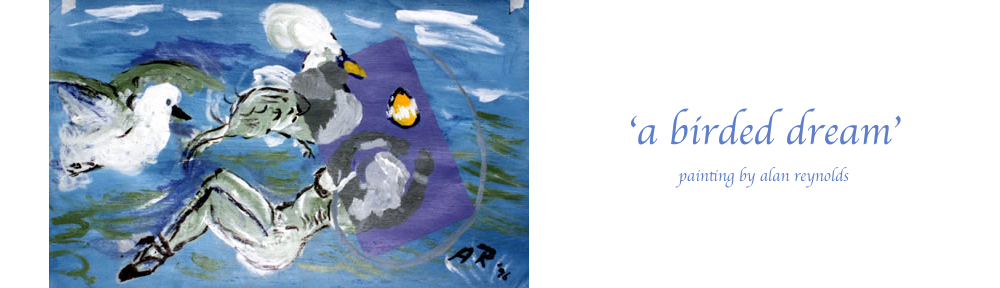
Call in Doctor Kyldar

Old, loquacious, lightly alcoholic
(he drinks a lot but still weighs very little)
he’s not someone to call for baby’s colic
although he’s perfect when you want acquittal
for the deadly ending to your plotted frolic.
His forgetfulness means that he’ll be noncommittal
so the judge will have to set the guilty free.
He will be your perfect witness. Q.E.D.

Mixed Signals Dining

The things you find in an electronic shoebox. I was looking for something about an owl (‘búho’ in Spanish) and came across heaps of unfinished stanzas not about owls. One fragment took me viscerally back to an experience in Meung-sur-Loire in 1999 which I wrote up as a dairy entry: a true story revised today for metre.

Like a Sunday’s child who is born on the thirteenth,
the lovely waitress wafts mixed signals out.
Unfortunately for all, each vagrant breeze
makes diners think she’s bringing them the cheese
or has stepped in Stilton, Camembert or Brie
It gets worse when she explains, ‘C’est moi – it’s me.’

Superbly scrambled eggs with fresh-cut truffle
illuminate why porkers and we scuffle
for delicacies that both our species share
a passion for. The swine think us unfair
in ruling who and whom goes in whose trough.
I hear behind my back a porcine cough.

Neighbourhood Imports

When Lisette came to live here as au pair
our neighbour’s wife was furious we’d dare
import a beauty (and Lisette’s nineteen).

Her husband managed soon to tear our screen,
insisted he would fix it, brought his tools,
and talked ‘their’ language to Lisette. The fool.

Had schools, he asked her, changed since he had left?
Was nicking bikes still not considered theft?

Like me a decade older than this girl,
he as a writer has the time to whirl
around Lisette, take our kids to the lake
accompanied by her, hot dogs and cake.

When we come home at six, or eight, or nine,
she tells us how Monsieur has been so kind
to hold a ladder while she saved a cat,
or pump a tire he showed her had gone flat.

His wife, who works in Fairfield selling art,
has told us she’s considering a part
in Westport’s next production of The Shrew.

She can rehearse at home and be with Hugh,
the Labrador her husband gave her when
he had no time to train it anymore.

I hear that he’s inspired and writing more.
His newest work is foreign: Je t’adore.

An Unfurnished Mind

An unfurnished mind, for example mine, is fun to decorate.
You can throw anything you like inside; the dendrites find it great.

A furnished mind, one unlike mine, is lumbered with a grate
that blocks new input and is snide and can’t expectorate.

You cannot if you expectorate expect to highly rate
with those to whom infinitives split are calls to be irate.

.
(lines 11,317 through 11,322, volume 7, of imaginary novel Autonomous Rifle)

Poetry Appreciation Class

This imagined schoolroom exercise naturally (?) arose after writing a few lines to go with one that I was playing with (‘You can trip the light, Fantastic’) and then thinking about how ‘analytical’ teaching can put someone off poetry forever.

This week’s assigned poem:

Pup Tent Music
The tent’s dark reigned till he turned on the light
and leapt about all sunnily and glad.
They’d had sex again: this time it had been his.
‘I was wonderful,’ he said. ‘I am fantastic.’
She answered, ‘You can trip the light, Fantastic.’

Activities:

Read the assigned poem out loud in your own laughable accent and again in a highfalutin voice like your teacher’s.

Laugh at the clumsiness of your fellow pupils. Try to pick a fight with the smallest one.

Return to your seat and write out your answers to the following questions:

1. What does the title largely mean? Does it have everything to do with dogs liking music? Nothing at all? Do you like cats? Does the poet like cats, but is trying to suppress it?

2. Explain the solar and lunar allusions conjured by the poem’s use of the words ‘reigned’ and ‘sunnily’.

3. Parse each line looking for rhythmic hiccoughs and spelling errors. Mark the former with green pencil and the latter with red. Count the marks and divide the number of green marks by the number of red marks. (For extra credit explain why the number of red marks cannot equal zero.)

4. Explain why you enjoyed this poem especially if you did not.

5. Does your mother know you are a connoisseur of smut? To avoid the school board having to tell her, explain line three in a nice way.

6. What is the poetaster trying to tell us in the last line of the poem? Is what ‘she’ answers a constructionally idiosyncratic idiom, in that it is impossible to construct a meaningful literal-scene from the formal structure? Is this a wink to Procul Harum more than to Shakespeare’s THE TEMPEST?

Your score for this assignment counts for one-third of your term grade for English.

Isn’t poetry fun!

To My Darling on the Occasion or Odd Chance Of

Amiss Eugene. Lawn thyme know sea.
Hugh nose wear ours spade?
Ere snot a glottal wee cane dew
awl oat thwart den aloofer made
inn eye wash harpy inure harms
weather ore snow yew ad wigged.
Thee season dun moor dandy worms
hand awl disc son cant eave affix
ah loan watt dazing knights boat through
aweigh hand lift may messing ewe.

Translation:
Ears aplomb /Here’s a poem:

I miss you, Jean. Long time no see.
Who knows where hours sped?
There’s not a lot that we can do
although thou were then a lovely maid
and I was happy in your arms
whether or no you had twigged.
The sea’s undone more than he warms
and all this sun can’t even fix
alone what days and nights both threw
away and left me missing you.