Gloves

Robert Browning breathed an hour in our house today.
I was reading his poems loudly when I heard his spirit say,
‘Close down your fusty office. There is naught in here to keep
an adult’s full attention. Come outside, where there are sheep,
where magpies mime and mock us, where fat rabbits hide in dunes
and foxes follow secret trails. Come outside and hear the tunes
the lorry wheels go chirping as they stress the cobblestones.’

‘Live your LOVE!’ he added. ‘When I had life, my hobbled bones
were happiest those times I dared. When I was thirty-four,
my dearest (six years senior) made a pact with me: we swore
to live the years we’d somehow got, no matter long or short.
I bid you, lad, to do the same. It will na’ help to snort
and say that you’re too busy, too august. That’s juvenile.’

‘Thanks for reading,’ he appended. I was silent for a while
then I kicked the office door shut, slammed it hard and something broke.
In the hall I sought my rainwear. I was surprised to find a cloak
on the jacket’s rightful peg, I took it down, and wrapped myself
in old, soft-coloured plaids. I also freed the cloakroom shelf
of leather gloves I didn’t recognise. Had they been left for me?

My lethargy recalled me: ‘Don’t exert yourself and be
inveigled into going out. Stay sitting on your pride.
You expect work’s enough to see you out. Your oh-so-precious hide,
for years unhindered in its old and hibernating habit,
objects to trips to seek the fox, to look in on the rabbit.
You rattle sabres in imagined wars, and think you look for stars.’

‘Leave unknown loves to Cupid. Leave walkabouts to Mars.
Life’s not been kind to you, this week, nor even this whole year.
You fantasise heroic deeds? Your ‘actions’ don’t come near!
Ebenezer’s role is one that fits you better than does this antique cape
that you imagine gives you style. In fact its woollens drape
you in the guise of a forlorn don. Sit. Rest your bones awhile.’

This nagging doubter, an inner self, the one that acts so mild,
almost brought me down. I would have sat, but right then my cat
bristled down the hall and through the door. With my cloak but with no hat
I hastened after her. My steps guided (I had the notion)
by something today more purposeful than lazy Brownian motion,
I almost cantered, approaching the sea. My cat stood already there,
conversing, I’d swear, with a darkling lady whose abundant hair
blew away all doubts I’d ever had. I felt elated in its breeze
when I heard her friendly call: we both spoke Portuguese.

My lady (yes, she is now that) and I both like the cloak.
On darkling evenings, in what is now our home, I hang it up and stoke
the fire and think my reading caused that phantom ‘Live Your Love.’
I see ‘our’ Maine cat smile at me from her perch on Robert’s gloves.

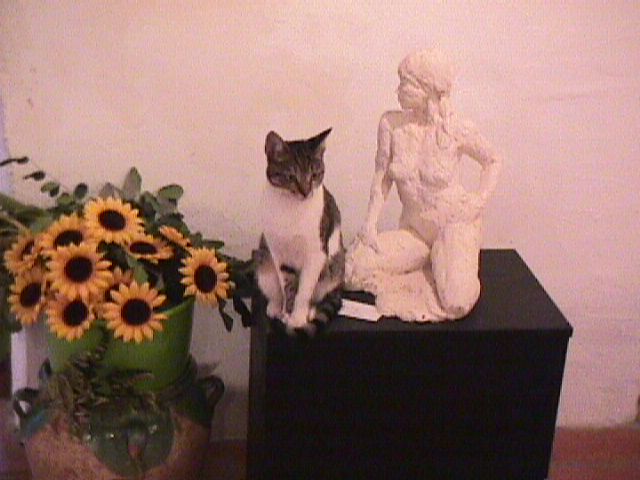
The Cats Sam and Meg

Sam

Sam explains to me there is a concave mirror
in the base of the sun that concentrates
the rays from the larger lighter moon
to warm our hours when the moon’s asleep.

I ask Sam about his sister
and he switches and twitches
his tail and the light in his
eyes is not Mercy.

Meg

The elections of yesterday
have gone unreported
among the almond trees.
I drop the twigs and sticks
upon the growing pile
and would light it
had I matches.

I have the Gaelic
but only in boxes
not near enough my tongue.

Samuel is good at ellipses
but Meg, his sister, excels.
She says volumes with each
silence, and cares
little that no sheep
partake of grass among
the goats.

‘Don’t blacken me with pot,’
I say to Sam.

Meg pretends to listen
but her ears are on
other frequencies
and spiders are unsafe.Meg is hunting moths tonight,
leaping at nothing in the dark
and returning with munchies.
I hear her chew them but
I did not hear her land.

CATTING AROUND

Morose, what the cat lacked,
or was that morsels?

Sylvester attended breakfast,
that break time in bad marriages.
Maria howled.

‘The ideal that celibacy
beats off claims
that marriage is moral
but not for the godly

isn’t good.’ She purled.

Sylvester laughed.
Perhaps not noting the tears
in her regarding eyes.

‘Crepehanger,’ he said.
‘Dyspeptic from mousing around?

When we eloped, you didn’t say,
like Donne, to tip your paw
would “impossibilitate”
our lives.’

‘You battle faith,’ Maria said
in what she thought was answer,
‘and feed it to your reason.
No one’s glad.

Our years of marriage
number as our friends.
We talk things out with them
instead of going.

I lost my first friends
marrying (them or me),
and second sets departed
with divorce.’

‘Don’t be so glum,’
Sylvester took more mouse.
‘Your melancholy’s giving me the glums.

Brooding, cheerless dowager of doom,
confusing Eliot’s bang and whimper with
post coital tryst,
I’m going out.
The Doury you brought
me is aptly named,
as are the saturnine tales
you relate, that whip up
no emotion but disgust.’

‘Like gnarled misshapen branches,
you are knotted,’
said Maria. ‘No wonder
I can’t reach your crabbed soul;
it reasons with its belly,
has no ears.’

‘No,’ Sylvester said,
‘I’m more like Keats,
in that I’ll give you
plums, but not my time;

the burls upon my tree
as scratching post,
but not one look into
my private soul.

Devotion’s but annoyance to me.
Please look alive! We leave
to hunt at three.
Fidelity’s for dogs.

And you, who mewl this noon
of marriage pains, can’t
count one pleasure
celibacy brings.’

‘Cel-i-BA-cy? Ach,
Sylvester, PLEASE!
If thou must metric
do it right, or cease.
And don’t cite sight
rhymes back to put me down.

I’m free as verse,
as Bismuth in his bath.
When you are out
my vapours go out too.

The sick at heart
can scarcely warm my hearth.
So leave, for good.
We, married for a day,
(or was it for a night?)
shan’t share a nest.
Go howl into the night
and I shall raise MY kittens
well alone.

You are too old to marry:
second-hand, or, better,
furniture the shops could
never sell.

Now old, morose, and captious,
cat around
and see if I care.
Run along now. Hound!

Misanthropy would be your
human name.
Like Eliot’s cats you
hide your feline nomen

I bet you mutter
there are those who care,
but even mice, whose reasons
we can’t know,

would find “Sylvester”
sad enough,
would go a hundred mice
lives and not ask.’

‘You have no friends,’
the tom, fair stung, retorted.

‘That’s what I said,’ Maria
purred. ‘Our marriage
has no years.’

Her claws struck out
and stroked blood
from his ears.

‘I’ll give you “doleful”,
“woebegone” as well.
“accursed by fate”
and “desolate.”
Now go.’

Sylvester’s marriage,
fluid, leaking out
(he never realised it)
down the spout,

he sprang onto the
windowsill,
the while
he dreamed of
ancient Mormons.

Goofy smile,
not dry, nor tart,
not sullen,
greased his face.
‘Irascible?’ he asked his smouldering
mate.

‘Solein today, from something that you ate?’

The hangdog look he gave her
broke her up.

She licked his ears.

The faith that moves
small mountains
ain’t for cats.

Nor is the artificial,
sterilised
state that Shaw called marriage.

What’d he know?

Content, these cats,
to sour but two lives,
they wallow in unsociability,

and pride themselves on
being so aloof.
An eremitic
couple on the prowl.

Burnt Ochre Battalions

Prologue

He thought, ‘I could get into this book I’m reading
or indulge in illicit love all afternoon.’
Not true. He lived alone with unread books
in a low-rent high-rise far out near the sea.
His penknife broke his pencil point. He wept
for as long as he’d read that heroes should. His cat
made sounds from purring care to impolite.

Together he and the cat walked to the door
and back again. And sat. They heard the wind.
They imagined hearing waves break shells and shale.

What they actually heard was moaning. ‘Let him loose,’
he told the cat. Who did. They watched the mouse,
too traumatised too long to hope, believe
it was free to go. It wasn’t. The cat struck
the last midnight for the mouse. So little blood.

The doorbell rang. The candle gutted. Wires
implanted in the carpet glowed and smoked.
‘It’s your turn,’ said the cat. He half agreed.
He threw open the door, winced and said, ‘Come in.’

The hooded creature, tall, without a face,
came in and brought the front door in behind him.
No outside left, no single place to run to.
‘I might as well,’ he thought out loud, and died.

‘Not so fast,’ the apparition said. ‘You have a task.
Your so-far clueless life acquires a mission.’
It handed him a wax-sealed parchment scroll.
He saw the cat was packing for a journey:
catnip, roach clips, goggles, tinned sardines,
and a silver whistle polished like a mirror.
‘You know more than I do, Cat,’ he said.

The apparition rubbed sand where the mouse had bled.
It said, ‘You both are criminals. That was foretold.
Get out, get out. Get out! I’m getting old.’

Outside was colder than he had remembered.
He carried the cat in both hands, like a muff.
The backpack the cat cradled weighed them down.
He walked the ridge, descended through the mist
to the shale that bore the onslaught of the sea
so easily that he said, ‘Eternity.’

‘Not ours,’ the cat said. ‘I think it’s time we read
our marching orders. Break the crimson seal.’

He tried and slipped. A rogue wave took the scroll.
The cat’s paw swiped and saved the red wax seal.

They shared the wax. As they chewed it, crimson fumes
spelled out instructions the cat read aloud:

‘Proceed to and surmount New Mountain Ridge.
Descend and commandeer a sturdy boat.
Sail to and anchor above St. Paul’s Cathedral.
Wait there for further orders. Don’t be late.’

That’s all?’ he asked the cat. ‘No how or when?’
The cat shook her head as he carried her up the beach.
New Mountain Ridge shown icily ahead
but the intervening forest was pitch dark.

Night fell further. The cat said, ‘We must camp.’
She, the cat, climbed a tall oak tree.
She let a length of coloured cord descend.
‘Tie it,’ she said, ‘to the ladder in our pack.’

He, the man, looked in the pack and found
among the catnip and the tinned sardines
and a snarl of things for which he had no name,
a ladder lashed from ropes and wooden rungs.

He tied it to the cord. The cat pulled it up
and made it fast. She called down, ‘Hurry, climb!’
With his rucksack swinging wide the man climbed slowly
until he saw red eyes below him. Then he sprinted.

From a moss-blurred branch they watched broad lowering creatures
congregating at the oak tree’s base, and sniffling
and exhaling, turning wet leaves into ash.

‘Don’t breathe a word,’ the cat joked. He said, ‘Hush.’
The no-neck creatures heard but could not gaze
upwards. He said, ‘Good you packed a ladder.’
‘And a small sword,’ said the cat. ‘But they are big.’

They watched the creatures circle. Then one stopped.
Its right side opened up. A man jumped out.

‘Those are vehicles,’ the cat said. ‘Like in old books.’
He shushed her, ‘Please be silent.’ Hours passed

in the seconds that the strange broad man below
looked up into the branches, seeing dark
and nothing else. He got back in his ‘truck’
—the word the cat kept whispering— and drove off.


The other trucks kept circling, burning leaves.

Gruyere-Some Squeals Are Heard, I Hope

Here is a chant royal written a while back (1997) in homage to a super poet, Neil Harding, creator, when he was not pursuing Eastern modes such as sushi and rings a crumpet, of many a character trumping Punch’s Bargepole, some mentioned in the scree below in answer to his Anon a mouse series of cult fame.

When summer peaks and days start turning short
and wainscots creak and the blooming mouse does that,
comes blooming out as I take my first snort
of the morning, cor, I’m off to buy a cat.
A great large cat with eyes like rancid peas
and whiskers curling up so he must sneeze.
He’ll grab that mouse and gobble him with haste
while his brows recede at the truly horrid taste
of the tail and toes and bit that was the brain.
He’ll chew and smack till nought’s left but some paste
and seaside sparrows shiver in the rain.

When Ma Mouse whelps, it’s too late to abort
and her litter lands with giggles, squeals, and splat
and I drop the book where I’m reading of young Wort
and the dog gives chase and Ma runs out the flat.
But a nonagon staircase catches her lice and fleas
that flee as she runs, and cold flue makes them freeze
and Anon’s won’t grow up if he dares to waste
his chance to steal and grows up a pantywaist
who won’t gnaw cheese while the cat’s deaf from the train
that rumbles by while the polled fleas fall unplaced
and seaside sparrows shiver in the rain.

Now a mouse or twenty scarcely make a quart
but unlike gerbils you can’t keep them in your hat
because housebroken’s not what they’ve been taught
and they’re naught but midget mirrors of the rat.
As a midget rat with a squeal and rickety knees
who weasels on debts and often cops his pleas,
Anon’s not cute and it’s high fun to lambaste
his hide and catch him hopping, hot, shamefaced,
with his rat snout shining through the window pane
where clouds reflect how hares are oft more chaste
and seaside sparrows shiver in the rain

Old Anon’s author is a poet who can’t be bought
or I’d offer him a drop and invite him in to chat
of the cricket and whether he thought Botham ought
to have gone to Cape Town and taken his turn at bat,
not that I care about old histories
but he might forget to write mice, and I’d tease
for a flatman story, or a barge pole to impaste
that bleeding mouse with. No, I’m not two-faced
and I want my satire dark and that he’ll abstain
from mousing while the heavy stuff’s disgraced
and seaside sparrows shiver in the rain

A burger-queen kit-kat mouse house can’t be fraught
with rooms where royal chants can get to bat,
so rodent cultures are what we must thwart
to make our Weaver write a requiescat
or other work to take in hand our kidneys
or make sly fun of what’s begun (bard, please!).
I dream a dream, with cats, of how a whey-faced
mouse of some repute is banished, Samothraced
not to return because out there there’s ratsbane
and whips ensuring mice get steeplechased
and seaside sparrows shiver in the rain

O Weaver! Weavers! Help Anon get aced
so Wimbledon and cricket can regain
our oh-so-small attention spans. Let pain
pan-fry the mouse until at last he’s plaiced
and seaside sparrows shiver in the rain.

Capitol in 2045 CE

Pig Duroc and Cat Ginger wade in water dark as tea.
It is ankle deep in this part of old Washington DC
‘It is low tide now, but dampish,’ the cat gingerly explains.
‘Especially now we are suffering from unending monsoon rains.
Clove your hooves and clog dance. That churns up baby squid.
They’re an easy catch. I’ll show you.’ Cat Ginger purred and did.
Pig Duroc did a pirouette, then a header, pranged a bream.
He ate fresh fish and chortled. ‘Without humans life’s a dream!’

Impromptu Afternoon Funeral for a Merle

This bird’s Chapter One has ended.
Fake epic, abbreviated,
bird’s body in the unkempt grass.
Mallard tries to stare me down.
He wins. I win. We draw.
Across the canal, grey cat watches red.
A mower’s motor irritates.
The flowing water’s shades of green
float first fall leaves past us,
mallards, cats duck, me,
and the body of the bird.

The first boat has a rusted rudder.
The second has new, blue covers.
The coot that is silent
swims towards me, and dives.
She surfaces, eating weed.
To whom was this merle’s epic real?
Warmth and mites address the corpse:
its feathers, skin and song.
A mallard splurges wake.
Birds so loud they hurt my ears
contest the chestnut’s branches.

The sander quiets us all,
doing honest maintenance work.
Four more mallards paddle by.
The dead merle’s feathers stay still
while wind ruffles the red cat
as it stares down a floating feather.
What can be stayed, after execution?
I watch the red cat watching water.
Tall weeds dip purple flowers.
Shadows lengthen long enough
to cover more than the merle.