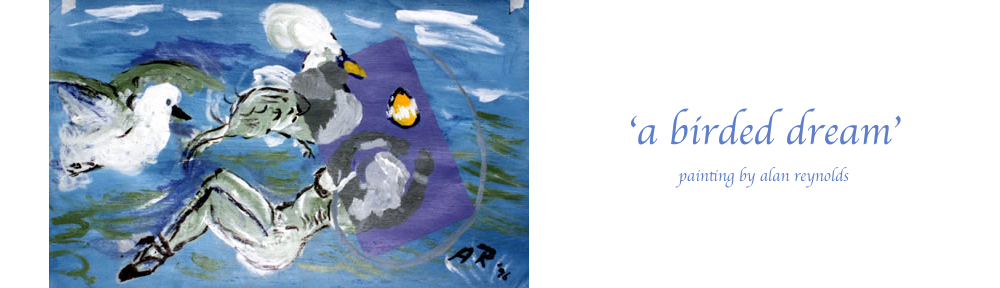
Tipping Point

The tectonic plates shift unceasingly beneath
the patter of our striving.
True to deeper dictates, the plates merge
motion into directions
each opposing the other—in a slow, mad whirl.

On the surface we chase happiness
as if it existed
in skirmishes won, in profits gained
at anyone’s expense—if we can bend
their wills and means.

What we call parties of politics
mirror the bloodlust shared
by men and rats
blind drunk on dark passion
when it suits them.

Facades of civility long nurtured
erode along a road paved
with short-term everything:
money resounds loudest when flung
after bad.

Climates of creeping entitlement,
promises made when it was easier
than not promising
come due, then overdue,
and are then exposed as shams.

New Himalayas, scaled to fit
our swollen views of self,
raise themselves among us
blocking all possible views of
shared humanity.

The solving of problems, always last
choice among us when empowered,
gain purchase and are then
discarded in orgies of name-calling
for what we dare not name.

Dreams purchased on the never-never
come due, and dilute, then,
into reappraisals
of what survival will entail
as we all buy guns.

The tipping point of a species,
this time our species,
breaks on the edges—
the conflicting, searing edges—
of the churning tectonic plates.
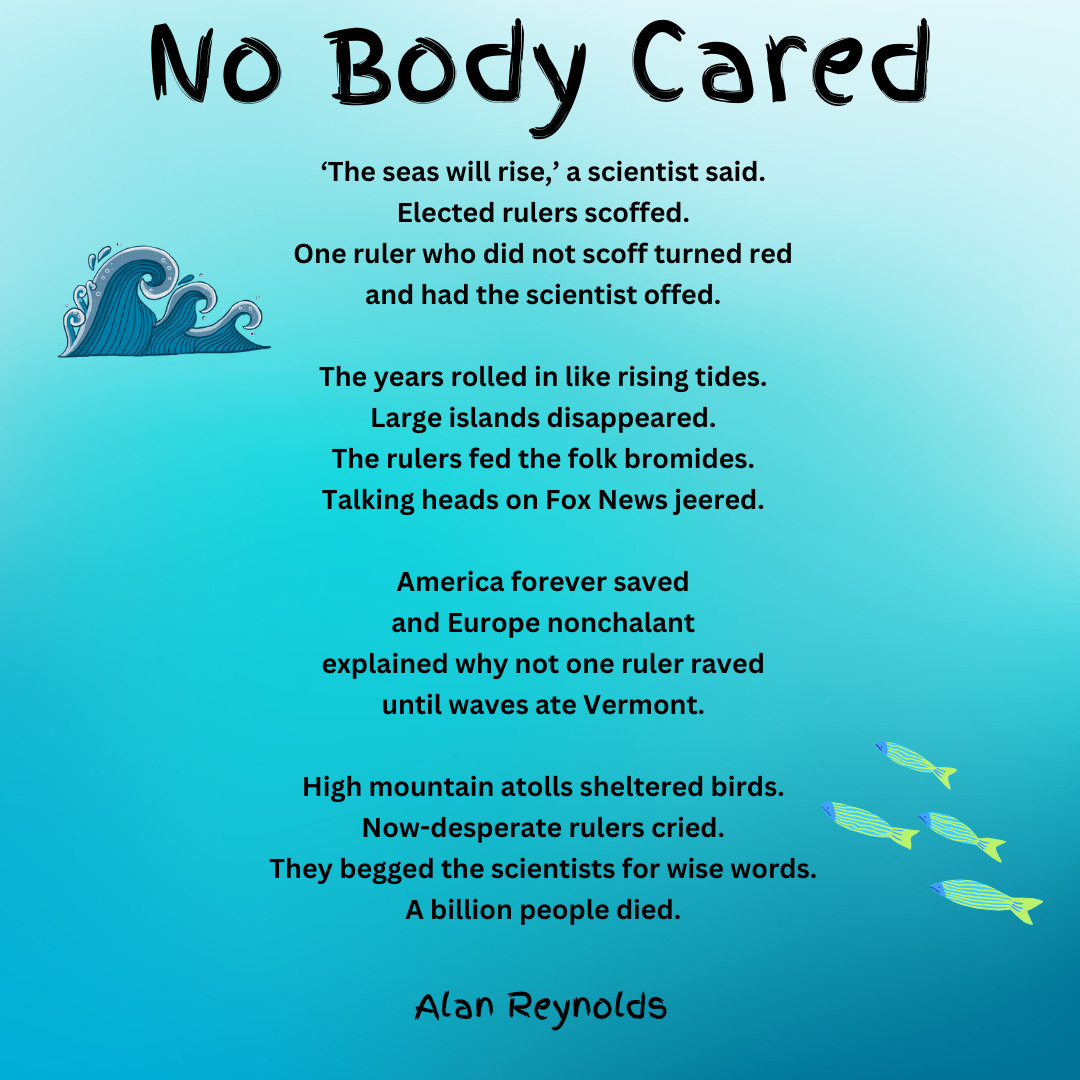
Supply Slide

‘To stiff a virus in mid song,’
clinicians say, ‘cannot be wrong.
So by extension it is we
whose work will set the planet free.’

‘No, by best logic it is us
(your ‘we’ is twee but who’s to fuss),’
say engineers, and build a road
as killing field for cat and toad.

‘We make the vehicles, their lamps,
refueling stops, and maintenance camps
so humans can ride roughshod through
the habitat of owl and shrew.’

‘With our aid fools can forests fell,
inverting lines that used to swell
with fair-caught trout. They are no more
now we’ve made nets and heavy bore.’

‘A piece of Heaven with a beach
was not beyond our tankers’ reach.
To those who washed the birds in answer
we sent a friendly warning: cancer.’

‘No, not warn thém. They all will die.
The warning’s for their friends who cry
and for their children left alone:
the world is ours hours to own.’

Clinicians treat the engineers
for nightmare, lower-colon fears,
and for their failing faith that they are right
to hide the stars with manmade light.

These same clinicians, when they quail
at questing for the Holy Grail
of killing other forms of life
go kick a cat or take a wife

or husband as their own advisors
and when that fails, hire advertisers
to put a better spin on things
and blow expensive smoke that rings

the bug-free swamps and empty fields
with figures of fantastic yields
of crops that look superbly neat
and that sport a shelf life you can’t eat.

The advertisers takes the wages
that they are paid to serve as sages
and buy furred robots, shiny cars
and sell us colonising Mars.

Care Too Late

Smoke hangs over deep cold waters
fed by tumbling mountain streams.
Bears and otters watch the smokestacks
stain the mist banks. Gaia dreams.

Gaia dreams of when the planet
was a place that species shared.
Gaia struggles with her nightmare
remembering when events had paired

one sort, humans, with the power
to learn how to force their will
on at first a few small moments.
Now they’re monsters growing shrill

in her dreams and in the actual
world that she sees sickening.
Gaia names the man-made monsters:
agriculture, splicing genes,

fashions leaving reason lonely,
cities rising, streets encroaching
everywhere until there’s only
room for humans, rats, and roaches.

Gaia needs man’s inspiration
like a corpse requires new clothes.
She deplores the susurration
of what human beings propose.

‘Bigger, better, obsolescence,’
cries man-built society.
Gaia, half drunk, acquiesced once.
Now she sees finality.

‘Cute when little,’ she describes them.
‘They make garbage of the world.’
She deplores their profit-plagued whirl
that’s left nature injured, curled.

‘Volcanoes I unleash will purge them,’
Gaia hopes. She is too late.
The molten flares can’t be a diadem
restoring what’s been lost to fate.

In a park paved by a president
who like Caligula adored death,
a badger poisoned by his words,
succumbing, cries with its last breath:

‘Gaia, save us, save yourself.
See the solution, pull the plug.’
Squirrels and badgers line the shelf
of creatures killed off. Gaia’s shrug

chokes on itself. She starts and wakes.
She calls the few still listening people.
She tells them what salvation takes.
She knows their faiths require a steeple,

something church-like: she tells stories
painting pictures of redemptions,
of women causing renewed glories.
Gaia and people share pretensions

that it’s not too late to save
what was beauty and in balance.
Armies march. Dictators rave.
Valour reaches to the valence

but no further. Hope expires.
Life itself, the constant wonder,
leaves the lakes and woods and shires.
Even microbes expire under

the weight of waste that’s gone before.
Moon-like, dead Earth gyrates senseless
unaware that once it wore
all the gifts that gods in endlessbouts of generosity gave
to a rock that spins in orbit
of the sun star—now a grave
with no one left to write its obit.

Threaded

‘Try to relax,’ says Guide Number 1. We watch the entire world ending.
‘Not all of the world,’ says Guide Number 2. ‘Just all the life that is on it.’
‘Not even all life,’ says Guide Number 3. ‘Only the species depending
on plants for food or for their food’s food.’ To us it is way past ironic

to sit stock still and watch Earth burn. There must be a way we can fix…
‘What you broke,’ say all three Guides in chorus, too-easily reading our thoughts.
‘You began small like birds, building modest nests with found bright stones and sticks
but progressed, that’s the very wrong word, to mess with missiles and dreadnoughts.’

‘Not all of us!’ we shrieked (here ‘shrieked’ is the very very right word).
‘We, and many like us,’ we whined, ‘adhere to the venerable thesis
of live and let live.’ Guide Number 2 said, ‘Do not be absurd.’
Guide Number 2, we knew, when we knew, was actually Lachesis.

She took our measure, of each of us, meaningfully waving the rod
we had hoped she had forgotten to bring. Clotho (her sister, Guide 1)
gave Atropos (Guide Number 3) a weary dooming nod.
Clotho vowed that in times future if any she would shun

spinning life threads for human people. ‘They are irredeemably bad
for themselves, for us and for ‘Gaia’ — whatever you want to name it,’
she said. She looked for an immortal thoroughly hauntingly sad.
‘They inherited the Earth but soon misused their growing powers to maim it!’

said Atropos. She smiled softly then. A Fate’s smile is disarming.
Could it be that our fate that threatened simply disappears?
We smile back. We try to laugh. The planet keeps on warming.
Then we see that Atropos is sharpening her shears.

We forget again, forgetting our Guides’ — these three dire Fates’ — true names,
and then from fright we forget our own. There is nowhere we can run.
The shears’ edges spark. Our threads spew smoke. Our souls go up in flames.
The Guides count down, the last thing we hear: ‘Three’ and ‘Two’ and ‘One’.

Wot Gnu

The lion’s coat, renowned in tribal vision,
is redolent close up of muck and dirt
and zebra remnants from the subdivision
of his last meal. Gazelles that you think flirt
with lions do so perhaps on television
but in real life the pride itself is hurt
by breath past fangs that flecked with unflossed prize
explain why lions converse with squinted eyes.

‘Who’s Wot Gnu?’ you ask. A magic gardener
conceived from little just like you and me
and thus with bugs and beasts and us coparceners
an inheritor of the sun, the fields, the sea.
Wot operates with me a veterinary
practice: we heal beasts to set them free
as they free us. They bring colour to our world.
We do not want a home that is not merled,
not foxed nor robined. We are for preservation
of rat-cheer rodents, sleeping ants, the chough,
and, in moderation, every nation.

‘What’s Wot got,’ you may ask, ‘to do with lions?’
I answer, ‘Everything from here to Orion.
It’s similar to asking how much twine
goes in a piece of string. All life is fine.’

‘What knew Wot Gnu to make you his disciple?’
you ask despairing of an answer clear.
‘Damn all,’ I say, ‘except he’s archetypal
of this whole confusing mess that I hold dear.’

Disastrous Reigns

Shadows claim me with a sense of obligation
that is the stronger since I know it is unfounded.
I stand in shallows of an edgeless river;
I try to remember towns that it contains.
I was born downstream of here in a coastal city,
a term we are forgetting now they are gone.
Behind me a dwindling people marches on.

I conflate thoughts no one should need to have.
The short disastrous reigns of evil emperors…
Rains, reins, reigns. It’s criminally late to care.
Whose fault is it we let democracy die?
Were Von Trumpf and Pinz the plague’s causatives or symptoms?
We groped too vigorously in the cookie jar.
When we broke it we rejoiced at the noise.

I conflate thoughts no one should need to have.
’Why not,’ Mad Hatter asked, ‘give war a chance?’
We did. We fought. We died. We are still too many
for Earth to feed, now we have broken Her.
We did not break the Earth. At most we scratched
or irritated Earth, till She broke free
of Her patience for the spreading skin disease

(I conflate thoughts no one should need to have)
we were to Her. Her ancient Deccan Traps
reopened. She ignited Yellowstone.
Stood in silt, I feel fish graze my legs.
There are no fish. Plastic trash is what I feel.
Plastic: the ice-nine we gave to Earth
before we began to capitalise Her Name
and venerate Her, the way we do with Things
and People once we’ve killed them and they’re gone.

Alone in shade-stuck shallows you’d think I’d drown
but someone sees and hails me. We march on.

DREAM STARS travels electronically

It is fun and new for me to have an ebook on Amazon I put my first one ever there on July 1. As a paperback it would take time for DREAM STARS to get around. But I hear the ebook has already been downloaded and read in far-apart places: Amsterdam, Colorado, England, Alabama, Ecuador …

DREAM STARS 1 July 2020 announcement