Making a Shuffle of Rare Bits

When I welsh on my rabbit he goes spare
attacks my ginger beer and ginger hair
with any simple tool that comes to hand.
There are so many. One that he finds grand,
the celt, a common prehistoric tool
I had to throw away before the fool,
flat hat on backwards, hatter shades or worse,
had used the celt to chisel me, the hearse
drawn up and weighing on his mortal soul
and wanting mine and perhaps the whole
of what I want continued for a bit.
There’s something else my rabbit likes: a brit,
the young of herring and related fish
from the Welsh word ‘brithyll’ and a tasty dish
for Anglophobes and Anglophiles and Phil,
my rabbit’s name. Sometimes I call him Bill
but that’s Dutch courage. When Phil drinks he’ll bore
the heart out of a haggis with his store
of hoppy tales; the one of the Scotch egg
is crumby, and his rare bit re the leg
of the dog that bit him is one I can’t watch
and he has others I attempt to scotch.
A hare is what is wanted here I know
now Phil’s rabbiting about his new Dutch hoe.
I’ll get my Irish up or else he’ll bring
in, ecumenically, the Rabbi Ting.

Gloves

Robert Browning breathed an hour in our house today.
I was reading his poems loudly when I heard his spirit say,
‘Close down your fusty office. There is naught in here to keep
an adult’s full attention. Come outside, where there are sheep,
where magpies mime and mock us, where fat rabbits hide in dunes
and foxes follow secret trails. Come outside and hear the tunes
the lorry wheels go chirping as they stress the cobblestones.’

‘Live your LOVE!’ he added. ‘When I had life, my hobbled bones
were happiest those times I dared. When I was thirty-four,
my dearest (six years senior) made a pact with me: we swore
to live the years we’d somehow got, no matter long or short.
I bid you, lad, to do the same. It will na’ help to snort
and say that you’re too busy, too august. That’s juvenile.’

‘Thanks for reading,’ he appended. I was silent for a while
then I kicked the office door shut, slammed it hard and something broke.
In the hall I sought my rainwear. I was surprised to find a cloak
on the jacket’s rightful peg, I took it down, and wrapped myself
in old, soft-coloured plaids. I also freed the cloakroom shelf
of leather gloves I didn’t recognise. Had they been left for me?

My lethargy recalled me: ‘Don’t exert yourself and be
inveigled into going out. Stay sitting on your pride.
You expect work’s enough to see you out. Your oh-so-precious hide,
for years unhindered in its old and hibernating habit,
objects to trips to seek the fox, to look in on the rabbit.
You rattle sabres in imagined wars, and think you look for stars.’

‘Leave unknown loves to Cupid. Leave walkabouts to Mars.
Life’s not been kind to you, this week, nor even this whole year.
You fantasise heroic deeds? Your ‘actions’ don’t come near!
Ebenezer’s role is one that fits you better than does this antique cape
that you imagine gives you style. In fact its woollens drape
you in the guise of a forlorn don. Sit. Rest your bones awhile.’

This nagging doubter, an inner self, the one that acts so mild,
almost brought me down. I would have sat, but right then my cat
bristled down the hall and through the door. With my cloak but with no hat
I hastened after her. My steps guided (I had the notion)
by something today more purposeful than lazy Brownian motion,
I almost cantered, approaching the sea. My cat stood already there,
conversing, I’d swear, with a darkling lady whose abundant hair
blew away all doubts I’d ever had. I felt elated in its breeze
when I heard her friendly call: we both spoke Portuguese.

My lady (yes, she is now that) and I both like the cloak.
On darkling evenings, in what is now our home, I hang it up and stoke
the fire and think my reading caused that phantom ‘Live Your Love.’
I see ‘our’ Maine cat smile at me from her perch on Robert’s gloves.
DREAM STARS travels electronically

It is fun and new for me to have an ebook on Amazon I put my first one ever there on July 1. As a paperback it would take time for DREAM STARS to get around. But I hear the ebook has already been downloaded and read in far-apart places: Amsterdam, Colorado, England, Alabama, Ecuador …

DREAM STARS 1 July 2020 announcement

Grammar Rules OK

It is almost midnight. She reads rules of Spanish grammar
in Dutch. This lets her fall almost asleep
until she wonders, what rhymes with ‘soporific’
and her mind’s off to the races. Ballads clash
with terse short-footed lines
in epics she remembers or might write
a dozen times again, each time forgetting
that she needs the sleep that’s purchased with the boredom
she can only find in studying grammar rules.

Letternijen

This poem is for Manuel van Loggem
who gave me pleasure with his meagre book
Letternijen that I read in from time to time
even some evenings before he died.
I liked his provoke-verbs, his sour tales,
his animals, and his japes at literature.
While they survive him in his book, perhaps some Where
exists where Manuel learns whether curse or prayer
worked better. As to which, I wish him well.


Manuel van Loggem in his 28-page book Aforismen en andere letternijen, uitgever, Deventer, Ypse-Fecit, 1989, 300 numbered copies:

‘Ik: Is er een leven na de dood?
God: Kom maar, dan kun je het zelf zien.’

Translations:
1. Me: Is there life after death? / God: Come on, you can see for yourself.

2. Yo: ¿Hay vida después de la muerte? / Dios: ¡Vamos, usted puede ver por sí mismo.

Les Uns et Les Autres

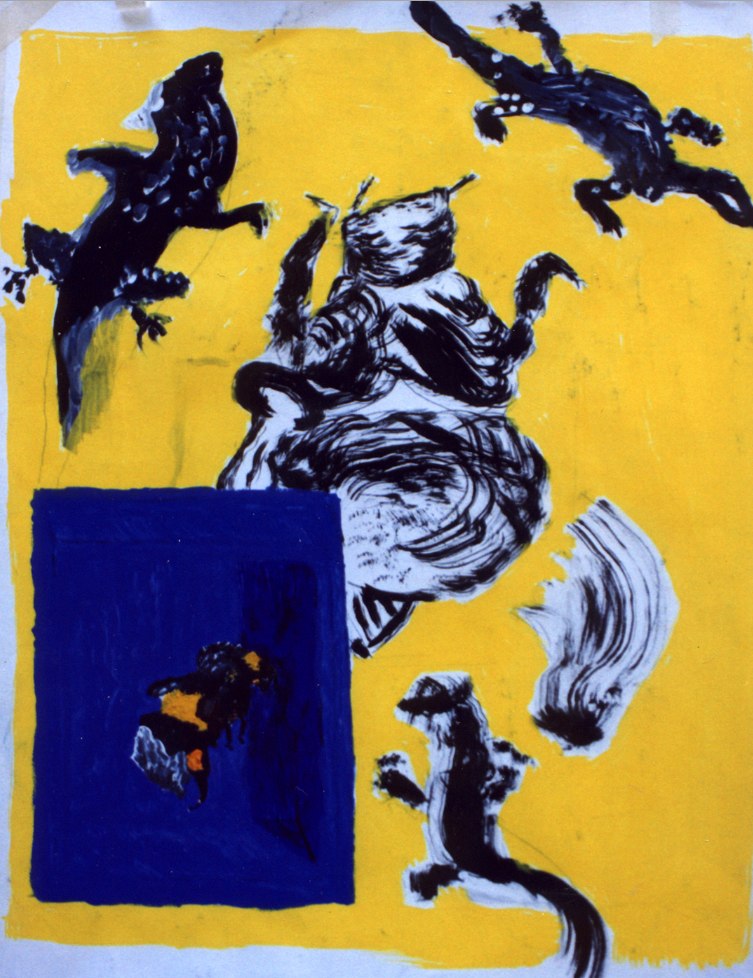
Les Uns et Les Autres

Alan Reynolds, acrylic on paper

These rough-drawn salamanders symbolise
the patient grace of Gaia as she pours
our molecules, in always-new reprise
of forms and folds and patterns she adores.

This bee, who’s dead, or sleeping in this box,
epitomises Gaia’s gayer pranks.
He’s sniffed the flowers, flown above the flocks
of sheep in April; gambolled near their flanks.

He bet he’d last the summer, and he might,
but only on this canvas, stretched and sketched.
Perhaps he’ll be recycled as raw light.
A full reincarnation? Too farfetched.

We dance in patterns we cannot perceive
but Gaia does, and pets us when we grieve.

Originally a 19th century silkworm nursery, the now legendary artists’ retreat ‘Beauregard’ in southern France nestled among vineyards, forests and Celtic ruins. It was where the artist Leo Musch (1943 — 2013) gave wonderful summer lessons, inspiration, and lodging to painters and sculptors.
One July morning Leo assigned a project where we were to paint something showing motion whilst leaving an empty rectangle somewhere in our paintings. He would tell us later how to use the rectangle. I covered my large sheet of gesso-treated paper with acrylic sketches of some lizards I watched playing, and of a bumble bee that fell and lay still on a table where I had been having coffee under the trees. I carried the bee around with me in a metal box, feeling he might have been sent to me as a model. Leo reviewed the pictures and instructed us to make different but related paintings in the reserved rectangles, showing some theme that would relate the two parts of the work. I sketched the bee (about twenty times) on other paper, then painted him in the rectangle, in a three-dimensional box that looked out into other space and time. Then I wrote ‘Les Uns et Les Autres’ to accompany my painting.