Were Worthy

‘Which words resemble me?’ I asked.
The Red Queen answered, ‘None.’

‘Is that use or mention?’ I inquired.
‘Do no words look at all like me

or’s None my doppelganger, Ma’am?’
There was silence in the Hall.

When someone laughed, ‘Off with his head!’
was what the Red Queen screamed.

Her liveried rabbits strode my way
and pointed tungsten pikes

at what I hoped was someone stood
behind me, and it was.

It was a password who still laughed:
it was my old friend Were.

Were simpered still, subjectively.
The queen, who’d been irate,

ripped the pike from the lead rabbit’s hands
and smote Were on his pate.

And what was Were right up to then
went weirdly inert.

From a nose bleed nudged by queenly pike
rose flowers on Were’s shirt.

I wished no more that I were Were;
were that so I’d be dead.

I woke and wept for Were who wasn’t
anymore, and left.

Causal Cautions

Do stories start in any sense that’s real?
I used to think so, till I met the cat.
I’d been hunting in the forest and the chill
had leached feeling from my fingers, and my hat
no longer blocked the rain. A chattering rat
had been the only mammal that I’d seen
and even though God knows that it had been
too long since I had eaten there’s a line
I would not cross, then, as to what’s cuisine.
A cat struck down the rat and said, ‘That’s mine.’

‘You spoke,’ I said astonished, and the cat
asked, ‘Was it yours? I’m sorry, here take half.’
And so began a conversation that
while less exalted than a rubaiyat
I had read once that a camel had composed
surpassed the monologue the rat had nosed
around for cheese. It ended in a wheeze
we savoured and then, sated, we both dozed.

Renewal

The jackdaws fly through snow, no trepidation
apparent in their wing beats as they soar
above this leafless tree, their destination.
The pair alights, returning home once more
to glom onto and clean the site that wore
their nest, then eggs, then baby birds whose flying
began from these stout branches. They’re denying
its hollow trunk to rivals who must go
find other nesting places, go on vying
and flying further through the flaky snow.

(for Dr. Sturman, who reminded me that there is more than bleakness)

Outing

He stands at his window and looks at the snow
and the wolf tracks in front of his door.
He takes his new phone – there is no one he’ll phone –
and makes photographs till he’s bored.
Then he sits at his desk, which is large and impressive,
and wishes depressively dusk
would absolve him of actions which in dark he can’t do,
but the morning has hours to go.
A bird whose black shadow was large as his desk,
when it flew over dropping those rocks
which had scared him, seems smaller in the tree where it perches
and he stands up and pulls on more socks,
a wool jacket weighed down with a Ruger Vaquero
in its holster he’d sewn in himself,
and a parka and gloves, and finally boots.
Then he genuflects, opens the door.

In Our Image

Outside a cottage, at the forest edge,
two predators watch people turn on lights
and set an oaken table. A terrine
of something smelling good is ladled out
and, after holding hands and praying, people take
up spoons and, as they say themselves, fall to.

The wolf looks on, disgusted how they slurp.
‘Soup eaters! Aaargh! They make my stomach turn.
Too-little mouths too often quickly open.
Too-nervous forelegs: twisty toes hold fast
to spoons glopflicking drops of moisture up
and into smacking mouths. This will not do.’

‘You are raving,’ says the Raven. ‘Get a grip.
Your ravening ways seem rare in turn to them.
Your mouth transects your face and you’ve no chin,
though that is good, describing me as well.
I hate soup eaters too. No one could think
that they’re beautiful; I sicken seeing knees…’

‘… that bend the wrong way!’ Wolf ends, with a grin.
He and the Raven glance at their own legs
and thank their separate gods they are designed
not monkey-like with legs that bend to aft.
‘I can think you are my equal if I try,’
says Raven, ‘Can you ever learn to fly?’

Cumuli

I sit in the sand to write of winter travels.
Out west above the waves the threat of rain
accumulates and then, again, unravels.
Lithe bodies whose perfection gives me pain
that someday they will go, a useless cavil,
implant their outlines in my grateful brain.
When winter comes, comes cold, and time to write,
and after those, the dark and endless night.

The night brings bombs that vaporise old timbers
and interrupt our squabbles with a mite
of understanding as the blast dismembers
a neighbour whom we knew but just by sight
and recognise no more among these embers.
A soul as fuel gives but little light.
Through what was roof the moon shines in to bring
my thoughts outside to search the dark for spring.

As racers race, as flyers tend to fly,
a couple couples four feet up the beach
with sandy knees and sheepish smiles that cry
for company, but they are out of reach
and I can’t be bothered. (Lord, forgive my lie.)
I write in blood and watch the paper leach
the words into it till the last sun sets
and coming winter cossets my regrets.

I need a moon, or more, to lift my spirit.
This war goes on forever and the fight
invades my night child’s mind and tries to steer it
to madness, as if safety lay in flight
from Eden now our guns arrive to queer it.
We pave the earth in ash to prove we’re right.
How long can we endure, and at what price?
Last summer’s waves go soft beneath the ice.

Some images I won’t report:
the way
the seagull hangs six feet above Lucinda …
the way a blonde, to enter the café,
takes forever, in the door, to wend a
shawl around almost her hips … ¡Olé! …
the way her sister, coming in to spend a
penny is garbed solely in a tee
shirt no one else notices … Such sights
are lost on those who focus on cold nights.

The darkness where night children I imagine
have hidden half the winter goes to grey.
Grey goes to rose, and breezes bring a smudge in:
reality, another one, gains sway
to order my perceptions as they trudge in
in lockstep till they learn they must obey
only what I want them to, then fly.
I imagine summer’s coming by and by.

Why should we celebrate the present summer,
take pleasure in the joys our bodies bring
themselves and others? Life’s a short-lived bummer,
John Calvin taught our elders, and each spring
ephemeral. It’s autumn that’s the comer.
Let’s hunker down, avoid the urge to sing;
await the fall, ignore sweet summer’s sight
till night falls down and proves the pessimist right.

Reality! A great stockpile of missiles.
We had to use them by their sell-by day.
I hunker as another of them whistles
inside to poach my lungs so I can’t say
“diddlysquat” or “kudzu” or “bulls’ pizzles”
and blood replaces breath. I kneel and pray
My monkey mind consumes another bummer
but my wild side senses all of life is summer.

It dies with us. All of it dies with us.
Wait for, want not, and polish your regrets.
I know I do. I raise a muted fuss
as I deny until my mind forgets
most of the gifts life’s given me. The fall winds muss
my memories: As each new gust begets
confusion I applaud how sand blurs sights
I lower daily towards eternal nights.

I watch Lucinda’s waving growing dimmer,
indulge myself (I try to do that more)
in knowing it’s through her I get a glimmer
of what of all I care about is more
important than mere living. Chances slimmer
than ever to get near what I adore;
than what I used to hope for, but all right,
I turn my face to summer, shut out night.
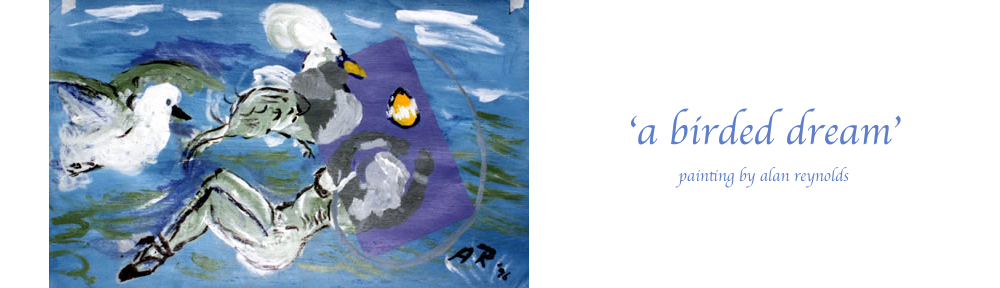
Yeti mother sneaker yet another speaker

(taking notes at a public meeting addressed by Mai Selph)

He slurs his words but whose words would you have him
slur, not those of yours nor Jesus Christ’s?
His verbal bons mots do not if you halve them
sum up to something better than what’s spliced
between the sheets, main braces and stale phlegm
that cross and short connections in his mind.

I’d be preciser but I’m being kind.
I’d be grammatical but he is blind
to what I’m writing here: he does not read
and more precision would not add one jot
to this jammy, namby-pamby polyglot
who stands before us speaking. He’s enthralled
by what he thinks he’s saying. Wan eyes glisten
as he assumes because we face him that we listen.

New Hero

My new hero is Mary Holtry.
    ‘Heroin’? No thanks.

Effervescent, cogent, witty,
    Mary plays new pranks.

Old plots, staging, battles raging?
    Through her they entertain.

I thank my pinup Mary Holtry
    and read her poems again.