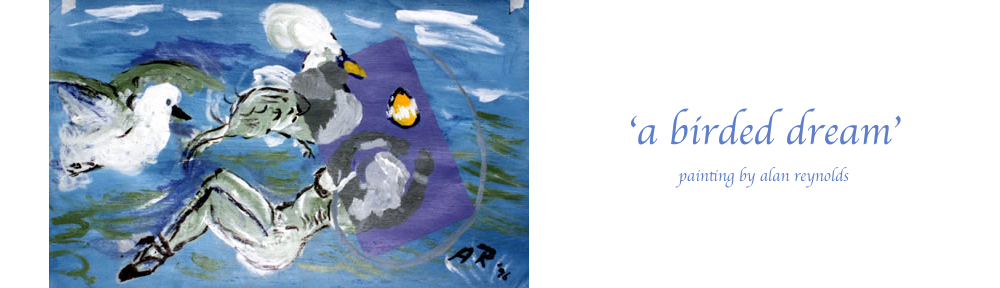
Twin Set Match

Living ’neath my expectations
and way the hail beyond my means
I nick Luther’s ancient pickup
and haul ass for Bobby Breen’s

’cause old Bobby’s got twin daughters
that in springtime give me chills
when they sunbathe in the pasture
where Bird Creek runs from the hills.

Chills that turn to fever as the show gets underway,
Red-hots that can corpse a man too dumb to stay away.

Folks down here fear reputations,
say Breen’s killed men in rage,
say that he shot creep bird peepers
with his double-ought ten-gauge…

(I’m gonna make my move today
and to hail with my cold fear
I have to see those honey twins,
four strong legs, long, up to here.)

…say he spied those peepers panting,
hunkered down Bird Creek’s left bank;
gave them both acute lead poisoning,
weighed them down so much they sank.

Folks say the twins cried, “Daddy, shoot!”
sauntered, dressing, making fun
of the creek’s pale rosy bubbles,
twin sets in the setting sun.

Chills that turn to fever as the show gets underway,
Red-hots that can corpse a man too dumb to stay away.

I act a little cool, half wise,
when folks tell me all this stuff,
glad they’re so dumb and forgetful
that I told them most of it

to keep the other guys impressed,
so far from Breen’s domain.
Laugh to see the yokels shudder
when they chant the old refrain:

Chills that turn to fever as the show gets underway,
Red-hots that can corpse a man too dumb to stay away.

Here comes Brenda bouncing blithely;
she’s the blonder of the two.
Where the hail did Ellie Mae go?
Can’t set sail with half a crew.

I step out and wave to Brenda,
shade my eyes against the sun
then spot Ellie in the shadows
as she raises her pa’s gun.

Chills that turn to fever as the show gets underway,
Red-hots that can corpse a man too dumb to stay away.

“We’ens hear you’ve bad mouthed Daddy,”
comes to me in stereo,
“The wrong you’ve done that righteous man
means now you will have to go.”

Brenda hurls a chunk of mine quartz
that I dodge but she just grins.
Ellie Mae sights down both barrels,
fires a round into my shins.

Chills that turn to fever as the show gets underway,
Red-hots that can corpse a man too dumb to stay away.

They drag me down the creek’s left bank.
I see buckshot on the rocks,
shreds of still-new stone-washed fabric
from red Wigwam hunting socks.

Both twins laugh me down like witches,
that’s the last sound my brain gleans
as Breen’s double-ought chops cotton
in my Calvin Klein blue jeans.
Fine Night Music

We’re dancing slow.  I hope the music never stops.
The steps you executed on the stage
are muted here with me, just subtle hops
the others hardly see.  You’ll be the rage
of critics who reviewed your play tonight.
But in this brown Café your pas de deux
blends fine with mine.  Times like this I love you.

You’re back so life is grand.  Please just hold me.
Your back against my hand is warm and strong;
the exercises work.  You look eighteen
but years more interesting.  It was wrong
to separate.  I’m still not right.
But in this brown Café your pas de deux
blends fine with mine.  Times like this I love you.

I know this city’s music, how its notes
attract us dancers, make us want it all.
It’s your turn on the high wire.  Jostling boats
of patrons call you.  They’re your fans.  Don’t fall.
But in this brown Café your pas de deux
blends fine with mine.  Times like this I love you.

Perception

Perceptions of the current, while they count,
contribute less success than would a paddle.
We put our oars in, hoping they amount
to mastering the flood-swept log we straddle
while shouting out instructions neither hears

while the river of the universe cuts slack
and lets us breathe a little while we tumble
to where we realize we can’t turn back,
and beyond the rapids’ roar we hear the rumble
of a waterfall that drops a million years.

I ship my oars and you throw yours away.
You turn around.  The sun makes you resemble
the girl you were our second wedding day.
Returning recognition makes us tremble
and the freedom of the hopeless lights our eyes.

We each slip toward each other, taking care
to keep our log from twirling while approaching
the eternal falls, and, when we’re almost there,
you lean and kiss me just when we are broaching
and The Us takes flight while something lesser dies.

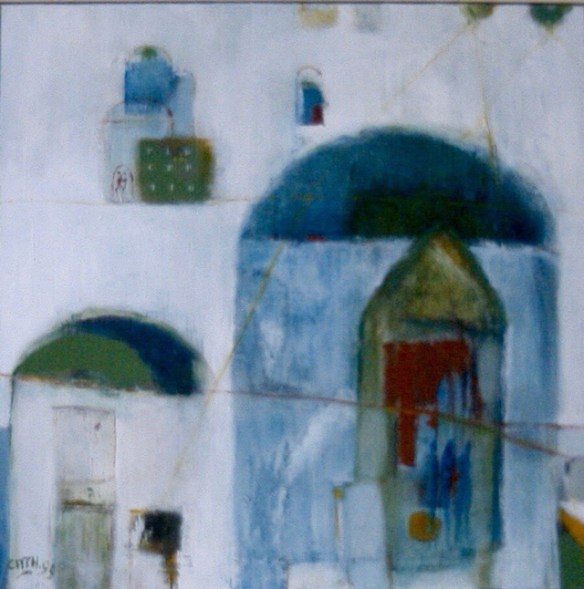
This poem was inspired by Catharina Reynolds’ painting ‘Perception’. The poem and painting were featured with accompanying music on Judy Labriola’s website ‘Euphoria‘.

Cloud Stream Fog Morning

Child waves
from car ahead.
She knows me then. Do I?
Who hangs here locked away behind
my eyes?

My eyes
see pain, chilled rain,
last waves, your laughed-at plans —
yet never look with any sense
at me.

Gray chill.
Men’s eyes cast down,
hands tending bending rods.
Cloud Stream hides golden fish as old
as God.

What are
these dire dead sounds
in dense fog near my head?
Youth dreams that toll away? My screams?
They go.


Cloud Stream Fog Morning appeared in March 1996 on the Aha!Poetry website and is still there.

Snake Eyes in Ireland

Saint Patrick, the only man to see green snakes
in Ireland where no serpent ever slid,
would screech ‘Hiss off’ at christenings and wakes
until the Pope sent envoys to forbid
the use of Irish whiskey where he preached.

He got religious orders and a miter on his hat
and drove away the snakes that would have reached
green Eire. He gave his whiskey to the cat.

When Irish eyes are smiling, the English say it’s drink
but tonight it’s ‘Up the Irish’ and it’s ‘Irish rule OK’
and I am not the only one who sees The Serpent wink.

It will be another year until Saint Patrick’s day
so dance while dram and Guinness pint are drawn
and mind your step. Don’t squelch that leprechaun.

Occam, let us adorn it

I think that I will never see
the point of tarting up a tree
too small to bless me with some shade
or fruit to press for lemonade.

A tree so minuscule to need
protection when the dachshund peed.

A tree if by a marmot climbed
would break and let him get enslimed
in mud dug up among its roots
by truffle-hunting bandicoots.

A tree attributed to chaps
who’ll stew a spaniel if it naps.

A bonsai tree whose fairy size
is meant some say to maximize
the egos of our human race
that loses little losing face.

A tree as large as broccoli stumps;
a sort of mushroom with the mumps.

A tree whose lumber would if pressed
fail to provide one decent chest.

Enfin a tree too small for me
to eulogize. A flimflam tree.

Pues, nada

While learning to speak real Spanish fluently probably requires being in a Spanish speaking country, Ben Curtis and Marina Diez provide online teaching services that make the process not only easier but also very enjoyable. They live in Madrid, which is her hometown (he is from Oxford), and they provide a host of online course materials including free podcasts and videocasts. Their choice of subjects and their engaging presentation make following them much more fun than the average reality television show, than any reality television show! You can find their videos on YouTube and via iTunes, which is also a handy way to get their podcasts.  Their websites are good sources, not only for Spanish-language studies, but also for information about traveling to or living in Spain: http://www.notesfromspain.com and
http://www.notesinspanish.com

Pues nada is a phrase that you often hear in Spain. Ben defines it as a good manner of making a pause in conversation. A literal translation could be ‘well, nothing’ or ‘then, nothing’ – with or without the commas – which may have something to do with the title of this new poem I am working on:

Pues, Nada

The survival knife, like hula hoops, has faded
from the public consciousness, Rambo entombed
with other myths attractive till The Bomb.

Then nothing. I can’t translate this short phrase.
It stays foreign to me like so many things,
their foreignness increasing as we age:
all things, and me. The knife lies on the floor.

It is useless here where bombs define the street
but, unlike many neighbors, it survived.

I read out phrases that street artists painted
onto the walls that last week were inside –
until The Bomb exposed them – bright green smears,
spray-painted text: Pues, Nada. Says it all.

The Cat of Whimsy – Why not call him that?
No one will read these words I write inside
what’s left of this apartment, and he purrs
when I call him that, or anything at all –
The Cat of Whimsy leans against my leg
then jumps across the big survival knife.

It’s not a game I’ll play, remembering lords,
or were they knaves, who fell upon their swords.

It has gotten light outside, so it’s light here.
One wall leaves little room for in the dark
when the sun starts shining. I avoid the cat
by looking at this paper. He returns.

He is thinking, just like I am, where we’ll eat.
Our appetites, so absent for the hour
or maybe days that followed the explosion,
return and bite us and we go downstairs.

‘Concrete poetry, what Israelis made
destroying Palestine’s American school…’

These lines offend me, word games making light
of what is so damned heavy that my soul
gives up existing. What is left goes down
what was the street last week, the garish paint
affirming that some younger people care
enough to try to use what they have left
to express their outrage. All they have is paint.

The Other Side, both Other Sides, have Bombs –
for here, for there in Gaza, Mexico
and everywhere that we sell arms. Who’s ‘we’?

I count. With cat and knife we’re only three.

‘I would not mind a steak,’ I tell the cat.
‘You can rhyme until the cows come home,’ he says.
‘This is not rhyme!’ I shout. We see no cows.

‘My point exactly,’ says the Cat of Whimsy.
He adds, ‘Pues, nada.’ We are lightening up,
our heads light from the hunger. Was it days?

The cat essays a joke on body parts:
‘My companion’s body parts mosaic seas.’

It’s atrocious, but we’re both atrocioused out.

A sweet old lady – ‘Sweet, she’s got a gun! –
doesn’t shoot us. Shakes her head. Gun-waves us on.

‘With gifts like these: no bullets fired, the sun,’
the cat tells me – I am shaking – ‘you’ll be fine.’

Bar Things at the Noon

I write away this morning and my life.
Merlot appeals and all the afternoon
goes gliding down a river that is rife
with might-have-beens and barkings at the moon.
These words aren’t foreign; they make perfect sense
in the places and vague humours where I live
among imagined pasts and precedents.
The wine ignites quiet memories that give
patinas to reflected pallid lives.
I tell them nightly till I think they’re true.
Perhaps they are. Realities have size,
the way gods do, depending on how you
describe them, and on how much true belief
you muster for them. Aspirin brings relief.