Crocodylus Acutus

The puerile croc up to his eyes in alligator flats
has polished off two kiwis: one cordovan, one black.
He much prefers, he leers at all, the polish to the paste
and says he bastes his choice more on staying power than taste.
Koalas smell of leaves they eat, and in the same way Croc
has belched himself an aura that locks vulture flocks in shock.
One fly-by of Croc’s lee side, they refuse to salivate
and chunder in their plumage. Croc waves and calls out, ‘Mate,
come down and swim with me and we’ll gobble monotremes,
amuse ourselves by snorkelling sharks and other creek extremes.’
The vultures retch incurably and curse big reptile geeks
as blithe as kookaburras with two geckos in their beaks.


Published in MÖBIUS, May, 1998.

Seeds

I am not sure exactly who I am
nor precisely who it is that I am not.
We meet and mingle without smoke or sham,
then separate, but share a common lot.
Not empathetic any way that counts,
we are more a blurring of the borders books
ascribe to personalities: an ounce
of human-kindness traits, a pinch of rooks’
and God knows what. In forests I am trees.
On beaches I am cloud and surf and sand.
I am the universe each time I sneeze
and it is me each morning when we stand
on the bridge to all tomorrows, and the rain
comes down like prayer, and we begin again.

So Many Wonders, So Little Time

A hot big-bang describes the start
of this our universe.
Does that explain why teeth feel pain
or why this tale’s in verse?
To say birds fly because they fly
is talking through my hat.
It isn’t wrong but unlike song
it’s both too sharp and flat.
If you were dumber I’d seem smart
but that is not the case.
I see you want to find out Why.
Why don’t we have a race?
Let’s start off slowly: physics first
then chemistry and math.
Their dinky hurdles are not tall
enough to block our path.
We’ll run by frozen accidents
that pave the way to life
and run uphill while force cements
complexity that’s rife
with run-on sentences that stop
most runners in their tracks.
They won’t stop us; we’ll set up shop
in logic and brass tacks
and when we tire of calculus
of how if ‘p’ then ‘q’
we’ll race to board an omnibus
to view the primal stew.
Description’s easy (well, it’s not
but I’ll let you explain)
so I’ll describe and you’ll tell why
and that way we’ll both gain.
This race might take all afternoon
so bring along your mind
to exercise it as we run
from Darwin to the kind
of husky question I can see
there cooking in your brain.
Let’s run uphill until we’re tired
then run back down again.

Ferretería

(a ballad occasioned by my consternation on
learning that a ‘ferretería’ is only an ironmongery)

His four feet fastened ferret-style
upon the olive branch,
Raúl resents the tourist’s rude
‘If that’s a mink, it’s ranch.’

Raúl runs out the open cage
and up the tourist’s leg.
As ferret passes trouser cuff
the tourist starts to beg:

‘Oh, spare me from this maddened mink
or pocket kangaroo!
It’s not my fault. I didn’t want
to shop inside this zoo.’

Raúl, well in the dark by now,
is frightened by these cries
and charges on to private parts.
He can’t believe his eyes.

In general a ferret stops.
A major problem, see:
will Raúl, so incited, al-
ter corporeality?

The owner of the hardware store
can captain ferrets out
but doesn’t know where Raúl is,
or understand the shout.

The tourist turns bright green with fear.
The ferret gets stuck in.
You’d think he’s at the colonel now,
not only at the shin.

‘Ironmonger,’ screams the tourist, high
of voice and on fear,
‘Retrieve your beast, be admiral.
Protect my lone-star rear!’

The monger thinks the tourist mad
and telephones the cops.
The ferret’s met their dogs before
and so he simply stops.

Down trouser leg, he lopes to loo.
Tenant plans has he.
He’ll lurk there till the tourist goes,
or stops in for a wee.

Encapsulation: Daniel Defoe’s ‘Robinson Crusoe’

Having enjoyed ‘How to Become Ridiculously Well-Read in One Evening: A Collection of Literary Encapsulations’ edited by E.O. Parrott, in which poets wrote short (and some not so short) poems telling very briefly the stories of books, I decided to try to encapsulate Daniel Defoe’s 1719 novel ‘Robinson Crusoe’:

( A ‘soe’ is a tub, of various kinds, and varying to some extent with the Scottish or English locality.)

Encapsulation: Daniel Defoe’s ‘Robinson Crusoe’
Against his parents’ wishes Robinson Crusoe
sets sail from home, not in a Scottish slew soe
but an English ship, that pirates from Salé
take over, carting RC faraway
where he becomes the moored slave of a Moor.

Escaping with a boat he’s been befriended
off the western coat of Africa, then’s ended
as an owner of plantations in Brazil.
But where there’s weigh of anchors RC’s will
sets him at sea and soon he’s sailing more

or less in straight lines back to Africa
to catch himself some slaves but not a chica
’cause sex don’t raise its head in Defoe’s prose.
Some sort of anti-slave god I suppose
sends a big storm. RC’s shipwrecked, cast ashore

in 1659, and he’s lost his companions
and the ship is breaking up in frightful canyons
of water and the wait until it sinks
seems very short. It’s fortunate he thinks
to fetch himself and key supplies ashore.

He builds a habitation, reads the Bible,
domesticates some cats ’cause rats are liable
to eat him out of feet and shoes unless
the cats or Bible help. He thinks he’s blessed
for missing naught but humans on this shore.

Some nights RC’s awakened, terrorised
to see arriving cannibals tenderise
their prisoners which they devilishly saté
save one he saves and christens Man Friday.
You know the rest so I relate no more.

Landed

The fish caught seconds earlier, not dead
but less than happy in the summer air,
lies pressed upon the bank’s long grass and reed
until his captor cuts the hook with care
and tells onlookers while a fish may bleed
it can’t feel pain. Like it, onlookers stare
until it leaps. Then, noticing it’s free,
the fish regains the stream, the lake, the sea.

We too played fishers when our world was young,
and hooked whatever bit, and profited
for many noons, and now that shadows long
themselves for cover, we call salmon squid
and quid for quo stands for our marching song.
When you asked me did I love you, then I did,
and we, proud we had legs, took evening walks
investing energy in whispered talks.

What hooked us and we looked upon as love
while reeling, each of us, the other in,
was evolution, golden treasure trove
of progress down from mindless bug to sin
and up from there to faith in an Above
elusive as it’s precious. Don’t begin.
We’ve heard each other out too many times
and know what happens when one of us climbs

beyond our station. Our red-marrow bones
lack the air fillings of the natural flier.
We sink, in spite of aspiration, home
into the river. What was our desire
gels into habit, and inside our room
we throw each other’s papers in the fire
we hope will keep the creeping cold outside
with the dark we sense approaching our blind side.

The salmon who escapes the dam, the bear,
and anglers paying through the nose to kill,
spawns far upstream, at home for its last hour.
Depleted, safe, successful for a spell,
it glories in the sunset of its power
before the scavengers eat its free will
and its predestination, and its flesh.
So little of us passes through the mesh

of the nets that are our destiny, our death.
Descended from the fish who chanced on lungs,
we each, more relative each passing breath,
say absolute good-byes. As sapient beings
we think we know that absolute’s the dearth
of love and living, a sinking pond rock’s rings
that can’t feel pain. I hurt as I break free,
and follow you in stream, and lake, and sea.

Occasional Guides

You have seen the open road of life
And how it drove us together
And what it did.

Dogs loose leashes, lose lives
Chasing life’s pleasures
Across roads.

Your wolfhounds, melancholy,
Gaze at life’s rabbits,
Electrical implants

And invisible tripwires
Keeping them immortal
Until blackout.
—————

You think I continue appreciating
Your forever improving me
But I cannot.

The fires of passion burn forever
Exalting those inflamed
But not here

Where you polished time until
It gave up passing
And stood down.
—————

God, a slow writer for readers on speed,
Lights wires they have tripped,
Proclaiming laws

Self-evident should corpses read
Or the quick acquire
Infrared.
—————

Beyond time space is pointless.
I imagine this no way.
It works.

A heron and donkey barter nests
They eat or sleep in
While I dream.
—————

God fell on hard times
And consumed them.
The residue,

Less than the wafting ash of Gomorrah,
Had no atmosphere
To waft in.

My starship, startled by this
Information from
Black holes,

Changes course one-tenth and tithes
Three years of Hawking drive
Reversed.
—————

If God is in the details,
Then seeing them is where
Satan lives.

‘Blessed vision’ does not mean
Seeing many of them
All at once.

And knowing that what goes round,
Et cetera, can drive
Someone once sane

To where despair seems kindness
And sanity is mockery
Of the dark.
—————

My starship is quicker than time.
Light loses out.
I am its crew.

Starboard is on every side.
Why do you regret
That I am gone?
—————

There were momentous eternities
We squandered gaily
Which is the way

To deal on that plane
Where tripwires are
Invisible.

Of course you cannot phone
Me here because
I’m there.
—————

Earth, out of the orbit
Of God and higher meaning,
Meant home.

We headed there, crossing roads
And invisible tripwires
With but

Occasional twinges and tears
We took for nostalgia
As guides.

God beat us home
Where even your care
Had gone.
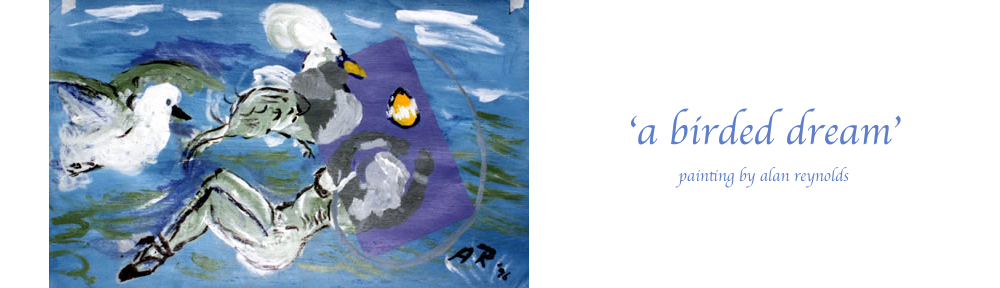
Mad Helmut’s Tea Party

Bloomsday. Today. The 16th of June, the date (in 1904) that James Joyce chose to let his character Leopold Bloom start out in UYLSSES. One word encountered in that book — ‘hyperborean’ — stirred up the Durac and the Slynog to celebrate at Mad Helmut’s Tea Party.

Mad Helmut’s Tea Party

‘I’m hyperborean as much as you’ Buck Mulligan to Stephen Dedalus in James Joyce’s ULYSSES

‘Compared to you I am much more hyperborean’,

said the Slynog. ‘I am also mad for tea.

While you, my addled, fat, and calm historian

remain inert, a late-lunch parolee

as like as not to be an absentee

when North winds blow up harder, heeling ship

away from where there’s harbour, landing strip

and tipples bar.’ The Durac rose and shrugged.

It heaved the anchor, gave the waves the slip,

and pointed to the shoreline their boat hugged.

‘Hypoborean I may be,’ the Durac said.

‘If that’s a word. You steer boats by their wake

and were you our navigator we’d be dead.

So slur on, Slynog. Don’t make the mistake

of thinking finding home’s a piece of cake.’

Together the companions hoisted sail.

Together they turned green, hung oar the rail.

The North winds blew, the duo turning blue

and blowing kisses to disgusted terns

they sailed strait home by way of Timbuktu.